Posts Tagged With: food

Sepen (Spicy Tibetan Dipping Sauce) and the Nightshade Fairy

Tawang Monastery, Arunachal Pradesh Tawang Monastery, Arunachal Pradesh

Tibet in a bowl!  I have never been to Tibet as such, but I’ve been close on a number of occasions, visiting various Tibetan regions of Northern India.  Tibetan culture is alive and well in India (unfortunately the same cannot be said of Tibetan culture in Tibet, but thats a whole different blog. post.  See here for more details regarding the present state of affairs in Tibet).  Once, on a hike in Himachal Pradesh (North West India) I thought I’d made it across the border when a Indian army fella popped out from behind a boulder with an AK-47 and politely asked me to turn around and don’t look back.  Shame, it was the absolute middle of nowhere!  Tibet looked like a majestic place, all icy peaks and vistas to take the breath away and inspire sheer awe..

Tibetan Monks, Tawang Monastery - March '14 Tibetan Monks, Tawang Monastery – March ’14

VEGGIE TIBETAN DELICACIES 

The food in Tibet is designed to fuel some of the worlds most hardy folk, many of them nomads.  Living at very high altitudes, with extreme temperatures and very little water, most Tibetans are rock solid folk and they need alot of sustenance.  Salted yak butter tea is one way of getting fat and energy into the body, but we would definitely not recommend it as a tasty beverage.  I normally opt for soemthing like Jasmin tea and Green tea is also common.

Tsampa is normal fare for breakfast, basically roast barley gruel (which grows well up there in the rare airs and windswept plains), sweetened or salty and we like to add banana to it for a luxury version.  Tsampa is lovely and reminds me of a very nutritious and fortifying ‘Ready Brek’ (a British brand of thin porridge that most kids were rasied on in the ’80’s).  ‘Balep’ is a light, spongy and chewy bread that is excellent dipped in a cup of hot tea on a crisp mountain morn.  ‘Tingmo’ is a light, dimsun like bun that is popular as a snack and can sometimes be found by the side of village and town streets, served straight from the steamer.  A welcome sight on wet and chilly day (seemingly very common in most of the Tibetan areas in India).

Noodles are an ever present and are made into something resembling what we’d call ‘Chow Mein’, sometimes with a broth, sometimes with bags of oil.  Basically different sizes and styles of quite bland noodles.  They normally call it Chow Chow, or they did in Arunachal Pradesh anyway.  ‘Thentuk’ is like a soft tagiliatelle noodle in broth which I find the most appetising way of noodling in Tibetan parts.  ‘Thukpa’ is another shape of noodle.  Seasonal vegetables are an ever present in these dishes and you normally get a good amount of greens mixed in.  The humble cabbage is well loved and creeps into most dishes.  Fermented bamboo shoots are very popular and add a wonderful flavour contrast to meals with a very, very funky smell indeed.

Our handmade noodle dish in Menchuka, Arunachal Pradesh. Our handmade noodle dish in Menchuka, Arunachal Pradesh.

We hand made noodles whilst up in Menchuka village, Arunachal Pradesh (the north east corner of India, sandwiched between Bangladesh, Tibet, Bhutan and Myanmar).  We were staying with a lady named ‘Nana’ and she cooked us local specialities every night.  These noodles were made as a second course, eaten after momos.  The stock used was the water left after steaming the momos, she added some local vegetables (grown in the garden) and greens to the stock and let it simmer for a while and there it was, a gorgeous bowl of broth-y noodles, one of my favourite foods.  Definitely what we’d call a ‘bowlful of soul’.  I like the way Nana used the steaming water from the momo cooking, this type of cooking trick makes me very happy, it always seems that more traditional cooking techniques are far less wasteful than modern and the zero waste policy is something that we try and put into practice in the BHK.  The beloved family Mithun (a cross between a buffalo and a cow, only found in A.P.) ate the vegetable scraps and seemed very happy with them.

Wild Mithun Mithun (when a cow merges with a buffalo)

Tibetans love cheese and make many varieties, normally using Yak milk.  Dried yak cheese looks alot like parmesan and certainly smells like it.  They also make fantastic little pastry parcels (like a British pasty) which I normally avoid as they’re stuffed with meat, like beef, or cheese. They do look delicious though.

Tibetans love a tipple and normally afterwards, a little boogie.  Chang (not the terrible Thai lager) is a barley beer drank in most households and distilled grain alcohol, called Ara, is something resembling rocket fuel that gets you there very quickly, especially when huddled around a blazing fire.  Falling over and dancing like a happy loon is quite common in Tibet (or maybe that’s just me!)

Being a vegan/ vegetarian couple, we find travelling around Tibetan regions quite easy, there are always plenty of vegetable based options to be had.  The ‘usual suspects’ on menu’s (mentioned above) can become a little repetitive, especially when compared to the fabulous diversity of food in the plains of India.

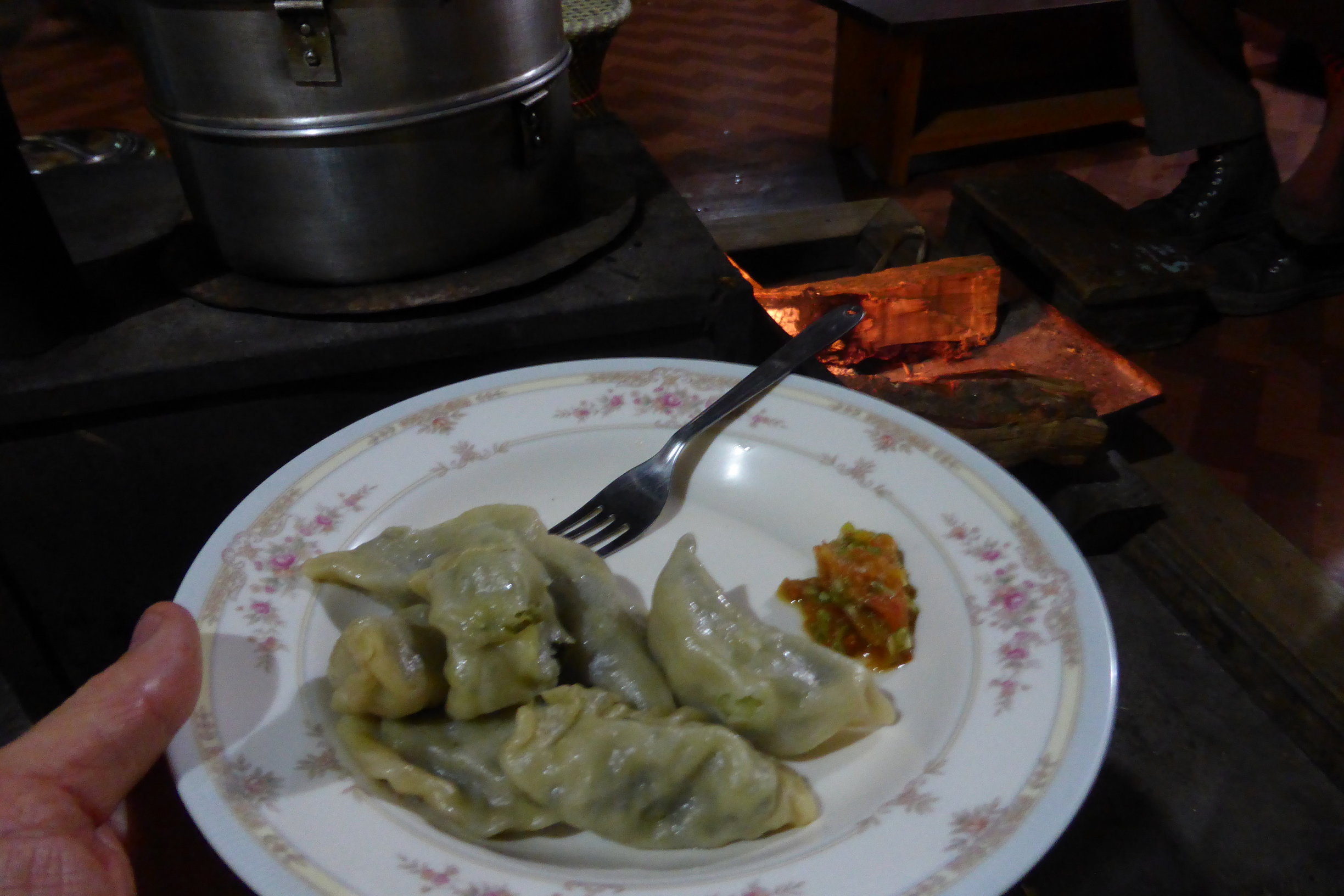
Probably the most ubiquitous of Tibetan foods is the mighty Momo (see here for our post on these bite size pockets of supreme tastiness) and Sepen, or something similar, is the sauce you will find on most Tibetan tables.  Momos are normally quite bland and need some jazzing up and this Sepen is the John Coltrane of condiments.

Menchuka high street, Arunachal Pradesh - March '14 Menchuka high street, Arunachal Pradesh – March ’14

This bowl of bright red wonderment is destined to accompany the MOMOS, but it also makes an awesome sauce to stir into noodles and can be used as a spicy little dip when canapes and nibbles are on the horizon.  You can use it like any Indian style sauce, stirring it into freshly roasted vegetables is a thing of extreme tastiness.  Its a good all rounder and one of our favourite things at the moment (even better than turmeric milk.  Yes, that good!)

This is pretty much the exact same sauce as you get in little momo shacks all the way across the Himalayas and to eat it in the Beach House Kitchen (North Wales) is quite a tastebud twister.  We have just recently been sorting our way through the local tomato bombardment, no not La Tomatina (that festival in Spain where they all lob tomatoes at each other), no, this is more like massive boxes of local tomatoes landing on our doorstep (twas the nightshade fairy we’re told!!)  We have been trying to figure out what on earth to do with the big old tom glut and sauces like this are perfect.  Ideal frozen (leave out the fresh coriander until you re-heat) we are amassing little red bags of sauces and chutneys all over our freezer.  Of course, Sepen is by far the finest, thats why we’re sharing it with you guys.
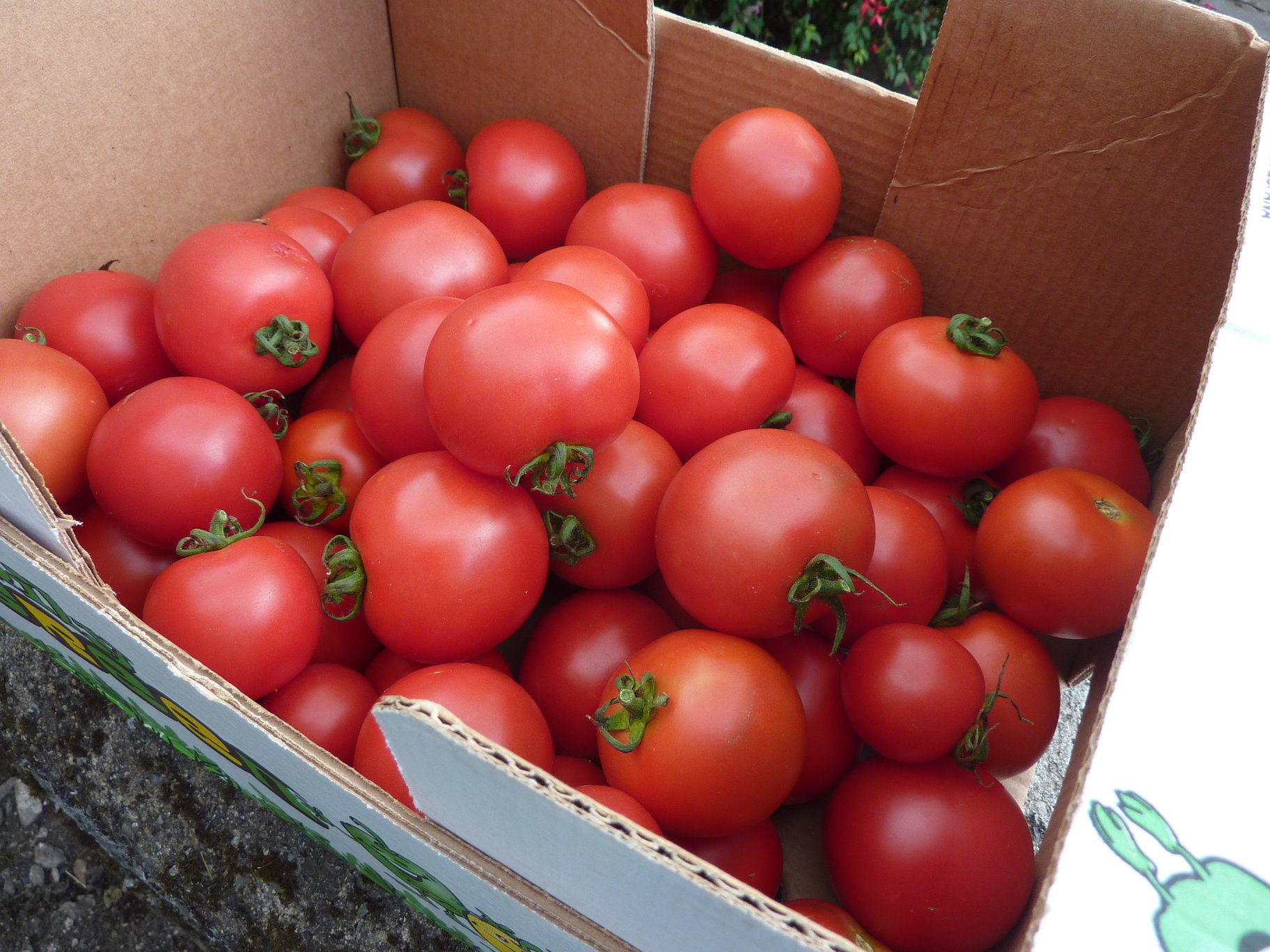
The work of the nightshade fairies (aka John and Pippa and their amazing farm in Bethel) The work of the nightshade fairies (aka John and Pippa and their amazing farm in Bethel)

Make a big bowlful:

The Bits

1 tbsp oil
2 tsp
crushed garlic
2 tsp
crushed ginger
¼ tsp
fenugreek seeds
1
dried red chilli (finely chopped) or 1/8 teas chilli flakes – to taste
500g ripe tomatoes
½ cup
fresh coriander (chopped)

Sepen in the pot Sepen in the pot

Do It

Gently fry the garlic and ginger in the oil over a medium low heat, taking care not to burn. After a couple of minutes add the fenugreek seeds and the chilli and stir until the fenugreek starts to turn a darker shade of gold.  Add the chopped tomatoes and simmer for 10 minutes, stirring occasionally, then blitz up in a food processer with the fresh coriander until smooth.

Serve

You can have this sauce warm or cold, both are very tasty.  Like most sauces/ stews, it does get better with age.  We’d recommend an evening of chilling in a fridge, to mingle and merge the beautiful flavours.

Couple of our mates from Arunachal Couple of our mates from Arunachal

Foodie Fact

We love our tomatoes and we love our raw food, but the two don’t exactly mix.  Tomatoes are one of the only fruits/ vegetables that benefit nutritionally from a little warmth.  Cooking tomatoes stimulates the lycopene (a phtyo chemical found in the red pigment of tomatoes and other red fruits and vegetables) content, but does reduce the vitamin C content.  For example, lycopene content in tomato paste is four times higher than that of raw tomatoes.  Its a balancing act, I imagine warm tomatoes are the way forward; not totally raw, not totally roasted.

Lycopene has been shown in tests to reduce the risk of cancer, but like most nutritional research, the evidence is debatable.   Tomatoes are good for you, eat them by the barrel-full (if you’re not allergic to nightshades that is!)  That’s the B.H.K’s advice.
Categories: Sauces, Travel, Vegan | Tags: , , , , , , , , , , | 9 Comments

Tibetan ‘Magic Herb’ Momos


Momos a la GayBoo Homestay. Made bt the magnicficent Nana and Gemma in Menchuka Village Momos a la GayBoo Homestay. Made bt the magnicficent Nana and Gemma in Menchuka Village

Menchuka, or ‘healing-ice-water’, is a small village in a remote valley close to the Tibetan border of Arunachal Pradesh, Norteastern India.   Menchuka has a real outpost feel and is inhabited by the Memba, Ramo, Bokar and Libo tribes.  A.P. is one of the most stunningly beautiful, tribally diverse and ‘off the beaten track’ regions we’ve ever visited. Its a tough place to travel around, good old fashion slog with rickety jeeps and random time tables (most leave at 5am).  Arunachal Pradesh is very rich in culture, which normally means rich in food tradition and it didn’t let us down.  We ate alot of Momo’s stuffed with all sorts of wonderful bits (normally cabbage based) but this little recipe by Nana really blew our taste buds away.  We made Momo’s or noodles together most nights and it became the highlight of the day.

Because it’s a stone’s throw from Tibet, Menchuka is an expression of what India stands for, which is surely the most fabulous melting pot of humanity, religion and traditions.  Surrounded by endless ancient forests, where tigers roam freely and with a stunning backdrop of the high Himalayan snowy peaks, it is an untamed wild-land where we felt on top of the world (in more ways that one, its sits at over 6000 feet!).  The land is extremely verdant, with seemingly endless virgin landscapes stretching over countless valleys and breathtaking waterfalls.  Transport is tough, small jeeps playing terrible pop music cling to the craggy and pot-hole ridden roads/ trails and the pace of life slows right down, sometimes to a halt.

Some people say that Menchuka is the fabled ‘Shangri-La’ but it was normally raining and cloudy when we were there, this is picture is taken from Wikipedia (we’ve been to this exact spot, but couldn’t even see the village below due to cloud cover).

Menchuka is the end of the road and it took three days travel just to pass through Menchuka Valley from the nearest large town named, Along.  Each valley and turn seemed to unearth a totally different tribal culture; with differing techniques for hut construction, cultivating the land and keeping livestock, worshipping nature and dressing in a usually flamboyant and vibrant fashion.  Some of our best memories revolve around the nightly fire in Gayboo’s Homestay with all sorts of rosy cheeked local characters; hitching tractor lifts along muddy roads with friendly locals (crammed in with the lumber!), searching for isolated Tibetan Monasteries and Monks in the misty pine forests, navigating our way around the local army base with the massive runway construction project underway, slurping chow chow noodles (think a greasy chow mein) with mugs of restorative hot water in local eateries and crossing wide white rivers on long and creaking rope bridges… we had a ball!

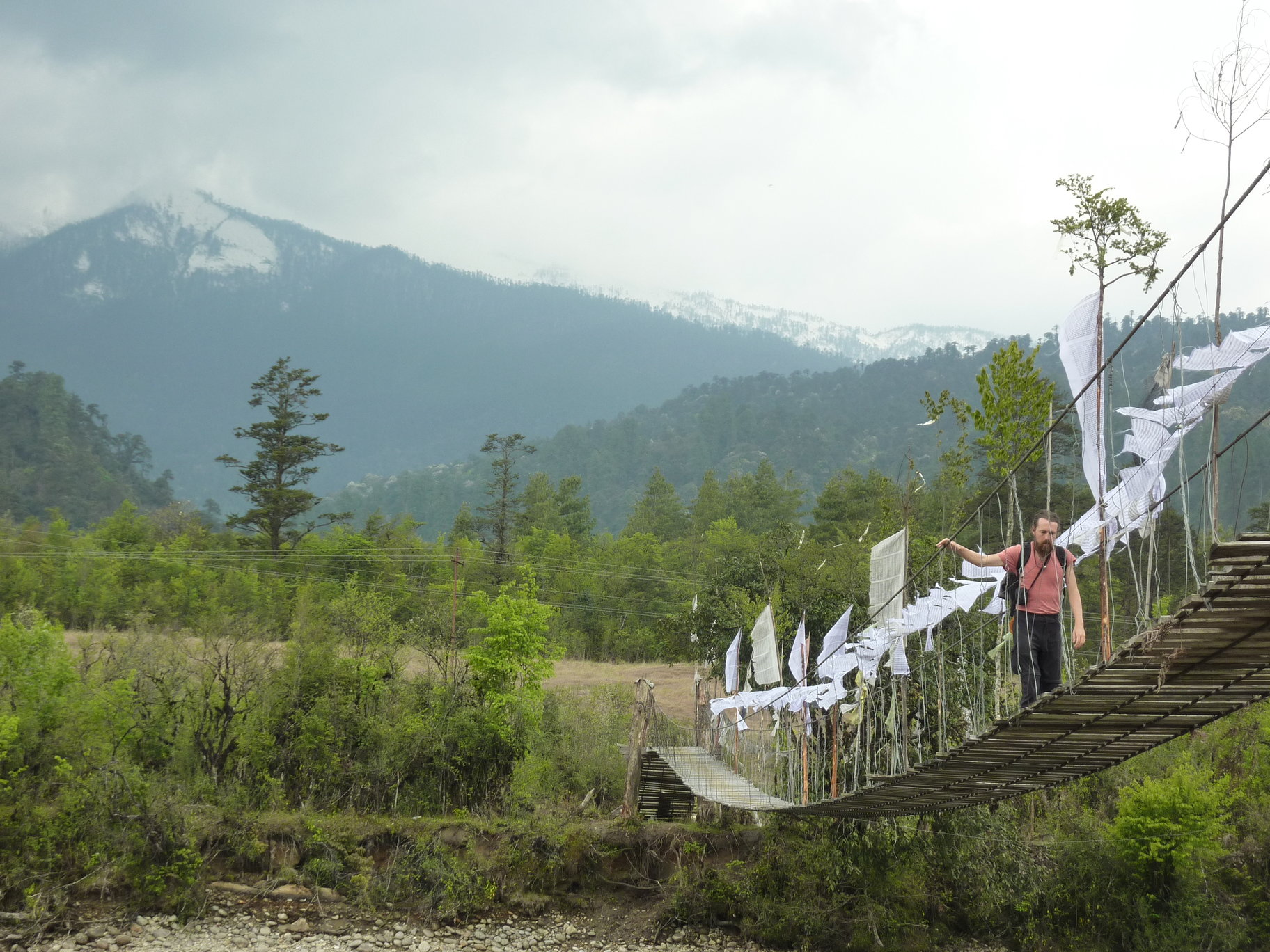
Crossing creaky rope bridges......near Menchuka, Arunachal Pradesh Crossing creaky rope bridges……near Menchuka, Arunachal Pradesh

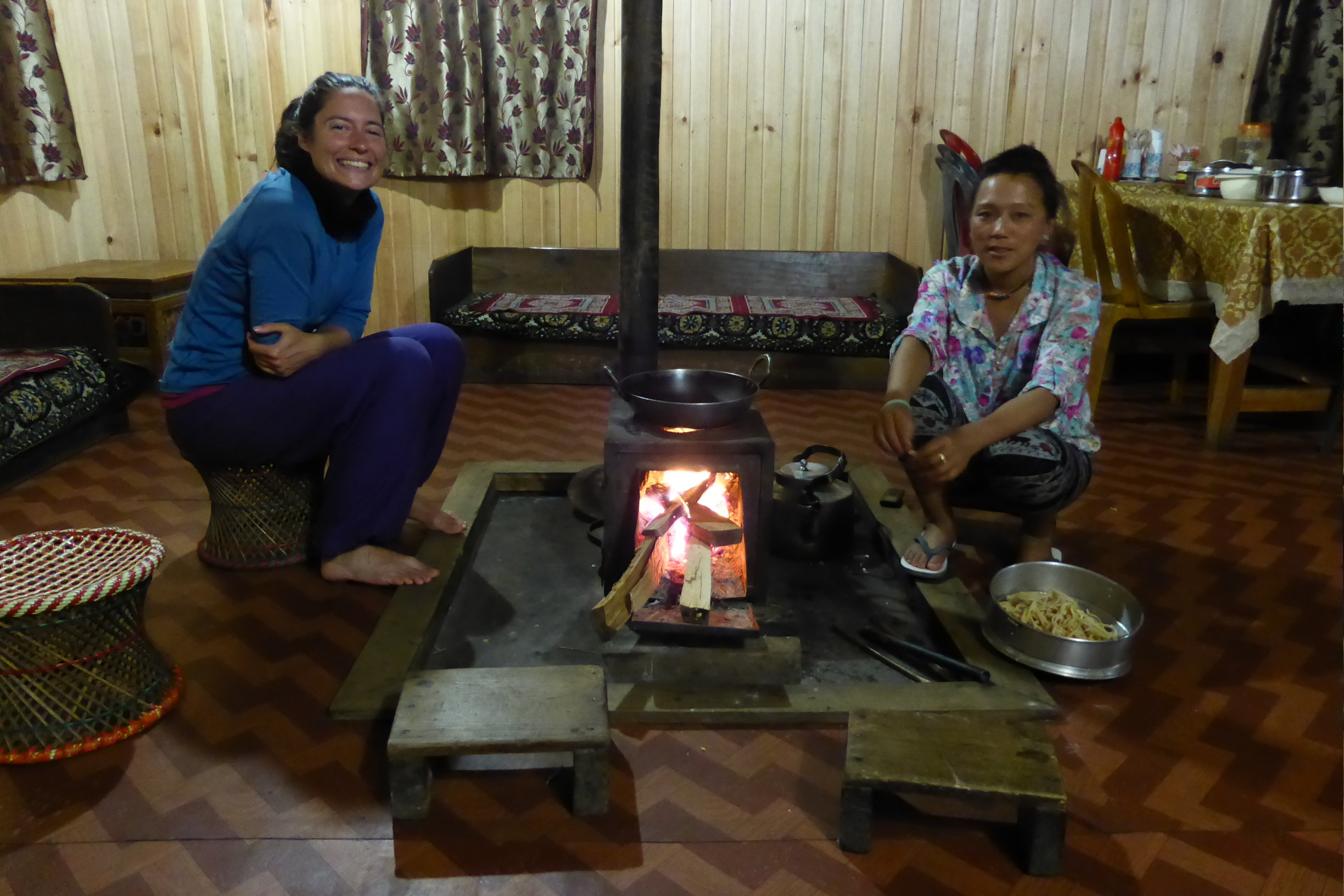
What made it extra special was finding Gayboo’s homestay; a small group of log cabins in the middle of the village. The only warm place was beside the communal family fire, where we dried out with a mug of hot tea after yet another damp and chilly hike.  Gayboo, and his wife Nana, made us feel like we were wrapped up in a warm blanket in our little sanctuary home in the mountains.

Our sweet and very kind hosts welcomed us with open hearts and bright smiles. They told us the tales of their lives, showed us photographs of carpets of Spring time wild flowers blooming in secret places, and made us all sorts of Memba (their tribe) specialties.

They also taught us the art of making  Tibetan Momos, their speciality dish, served with a tasty chilli herb dip, made from a recipe passed down to them from generation to generation.  These momos are really special, the real deal. Of Nana’s three techniques to wrap them I liked the so called ‘pinch-pull’ method which gave the Momo a classic British Pastie look.  There was also the ‘twist’ and the ‘crimp’, favoured by Nana’s daughter Gemma, which admittedly sounds like something out of the Mighty Boosh, but all will be revealed….…

Jane and Nana gettign warm pre-momo 'fest. Jane and Nana gettign warm pre-momo ‘fest.

The ‘Magic Herb’ mentioned in the title was intriguing at first, but turned out to be something very much like a whole Szchechuan peppercorn, which was bashed up and added to the mix.  A process we have repeated in Wales to a very nice effect.  The family gave Lee a whole peppercorn to chew on with comical, gurning results.  We would recommend going easy on them in their raw state!!!

The Bits – for 4 (makes about 16 momos – more if your dough rolling skills are good and thin)

Momo Filling
600g boiled potato (peeled and diced)
200g broccoli (grated)
1 medium onion (grated)
½ tsp chilli powder
2 cloves garlic (crushed)
1 inch ginger (crushed)
½ tsp salt
1 teaspoon oil
100g chard or kale (very finely chopped)
¼ teaspoon Szechuan pepper (to taste – you have been warned!!)

Momo Dough
2 cups white unbleached flour
½ – ¾ cup of water (depends on the type of flour)
¾ tsp salt
2 tsp oil

The Tibetan 'Cornish Pastie' The Tibetan ‘Cornish Pastie’

Do It

Get the potatoes straight into a pan of salted boiling water and cook until they go soft and mashable.

While the potatoes are boiling, slowly and gently fry the rest of the filling ingredients in the oil over a low/medium heat so that they turn nice and soft. Take them off the heat before they go brown.

Mash up the potato when it is cooked, then add the fried ingredients. Give the mixture a good stir, seasoning it just as you like it.  Leave to cool for a good hour until at room temperature.

Whilst the mixture is cooling down, make the dough. For this, mix the flour, salt and oil in a bowl and add water gradually until the texture is smooth and the dough is stretchy. Knead the douhg for a minute and then stick it in the fridge to chill.

Then roll out the dough into a big circle and use a standard sized mug or scone cutter to cut it into smaller discs.  The size doesn’t really matter, just not too massive.  Then get creative with your folding styles!  The ‘crimp’ looks like a little semi-circle, the ‘push-pinch’ looks like a Cornish pasty and the ‘twist’ ends up looking like a little ‘dimsun’ style ball with a twisty top. Lee is the ‘crimp’ king, I’m partial to a ‘push-pinch’. See the pictures for a reasonable idea about what we are getting at.

There may be some filling left over at the end if the dough is a little too thickly rolled (they will still taste lovely though, so no worries!). This filling is so delicious you can just make leftovers into little patties the next day, or just snack on it while you are rolling.  If you are Tibetan and an expert then you’ll probably end up with too much dough!  Nana’s Momos were very thin, but we are just beginner Momo-makers.  We had a little filling left over at the end of our rolling session.

Momo's steaming on an open fire.... Momos steaming on an open fire…….Gayboo’s Homestay, Menchuka

Top Tip – if you try and put too much mixture in each momo it splurges out of the end…..!

These tasty little critters can steamed or shallow fried.  We steamed ours, so lightly oil both the steamer and the Momos so that they don’t stick to each other creating a giant inseparable momo blob. They take about 10-12 minutes to cook through on a decent steam and when they are done there is no stickiness to the dough any more, and the filling is piping hot through.

Serve

We quickly and simply pan fried bok choi, courgettes, tamari and ginger to make the perfect veggie accompaniment; eating our fresh Momos near a picture of the Dalai Lama with our minds all Himalayan.  We always serve Momo’s with ‘Senchen’, a Tibetan dipping sauce.  We’ll dig out the recipe and post it soon.

Foodie Fact

Fenugreek is a fascinating plant – even the ancient Egyptians understood the benefits of fenugreek – it’s seeds were found in Tutankhamen’s tomb!

The health benefits of fenugreek include relief from anemia, loss of taste, fever, dandruff, stomach disorders, biliousness, respiratory disorders, mouth ulcers, sore throat, diabetes, inflammations, wounds and insomnia. What a plant!

Slow moving traffic, waterfall meets road in Arunachal Pradesh. Slow moving traffic, waterfall meets road in Arunachal Pradesh.

Wishing you all happy momo-rolling times. There are few things as satisfying as munching fresh Momos slowly as you’re rolling more of the delicious beasts!!!!!  It is a highly relaxing way to spend an evening away.

Om Mani Padme HumX

Categories: Recipes, Travel | Tags: , , , , , , , , , , , , | 11 Comments

Redcurrant and Chia Breakfast Pots

Redcurrant and Chia Breakfast Pot.  Ready for action!

Redcurrant and Chia Breakfast Pot. Ready for action!

All you need for this easy and gorgeous vegan breakfast is a food processor and a fridge.  It’s that super easy, lightning quick and totally nutritious.  What a lovely, healthy start to the day.

Chia seeds are one of the healthiest foods known to man and are the nutritious seeds of a plant related to the mint family!  Funky grass never tastes this good!! This tiny little seed acts a little like a sponge – becoming slimy and swelling up when soaked in liquid.  Because of this, chia is best served mixed into something creamy and delicious…. in this case coconut milk!  It can also be sprinkle on things liked salads or smoothies, like little seedy nutritional bombs!

This treat breakfast is also a perfect way to use up all those inevitable fruity autumn leftovers you (hopefully) have lurking in the corners of your fridge.  We had some mango bits and some red-currants that worked perfectly, in a very random way.  Sweet and sour…..bhom and mmmmmmm!

Any autumn berries would be find here, blackberries and elderberries spring to mind (as I can see them growing outside the window!)  We have an awesome little project planned for the next couple of weeks when we make Beach House Garden Jam for the first time.  Our plum tree has sought shelter under a dry stone wall, all the protected branches (from the vicious gales we get up here) are flourishing and its looking like a bumper plum crop this year.  Add to that a healthy Barsdey apple presence from our new apple tree and the ubiquitous blackberries swathe that is taking over parts of the garden and we’re looking good for tasty, sugarfree jam this year.  Does anybody know any good sugar free jam recipes?

For a more local/ accessible sweet fruit, why not go for a plum.  Oh, plum and blackberries, now we are talking in a sensation and seasonal fashion.

With bags of redcurrants at this time of year, what better way to use them?!

With bags of redcurrants at this time of year, what better way to use them?!

The Bits – for 4

1 cup of vegan yoghurt
1 small mango (or sweet fruit of your choice)
4 handfuls of seasonal berries (whatever you have in your fridge)
500ml coconut milk
1/2 cup chia seeds
1 date (optional added sweetness)
1/2 cup of linseeds
4 drops vanilla extract


Do It

Blend the yoghurt and mango and pour into the serving glasses.

Make a berry layer on top using half of the berries.

Next blend up the coconut milk with the date (it sweetens the milk a little), pour out into a bowl, and mix in the chia seeds, linseeds, and vanilla extract. Put this in the fridge for 20 minutes to cool and swell (or for as long as you can resist it’s charms for).

When the chia mixture feels thick-ish, pour it on top of the fruit layer in the serving glasses. Finally top with the remainder of the fruit.


Serve

Can be kept in the fridge for a couple of hours but better served straight away – dive straight in!


Foodie Fact

The benefits of Chia seeds are far and wide, with vast quantities of Omega-3 good fats and fibre being particular highlights.  Try drinking a large mug of lukewarm water with a chunk of lemon squeezed into it while you are preparing this breakfast, the perfect de-tox first thing in the morning.

Enjoy Xxx Sending you love this happy morning, Jane X

Cor!  What a pleasant way to start the day.

Cor! What a pleasant way to start the day.

Categories: Breakfast, Healthy Eating, Vegan | Tags: , , , , , , , , , , | 12 Comments

Spiced Beach House Chai and the Awesome Power of Cinnamon


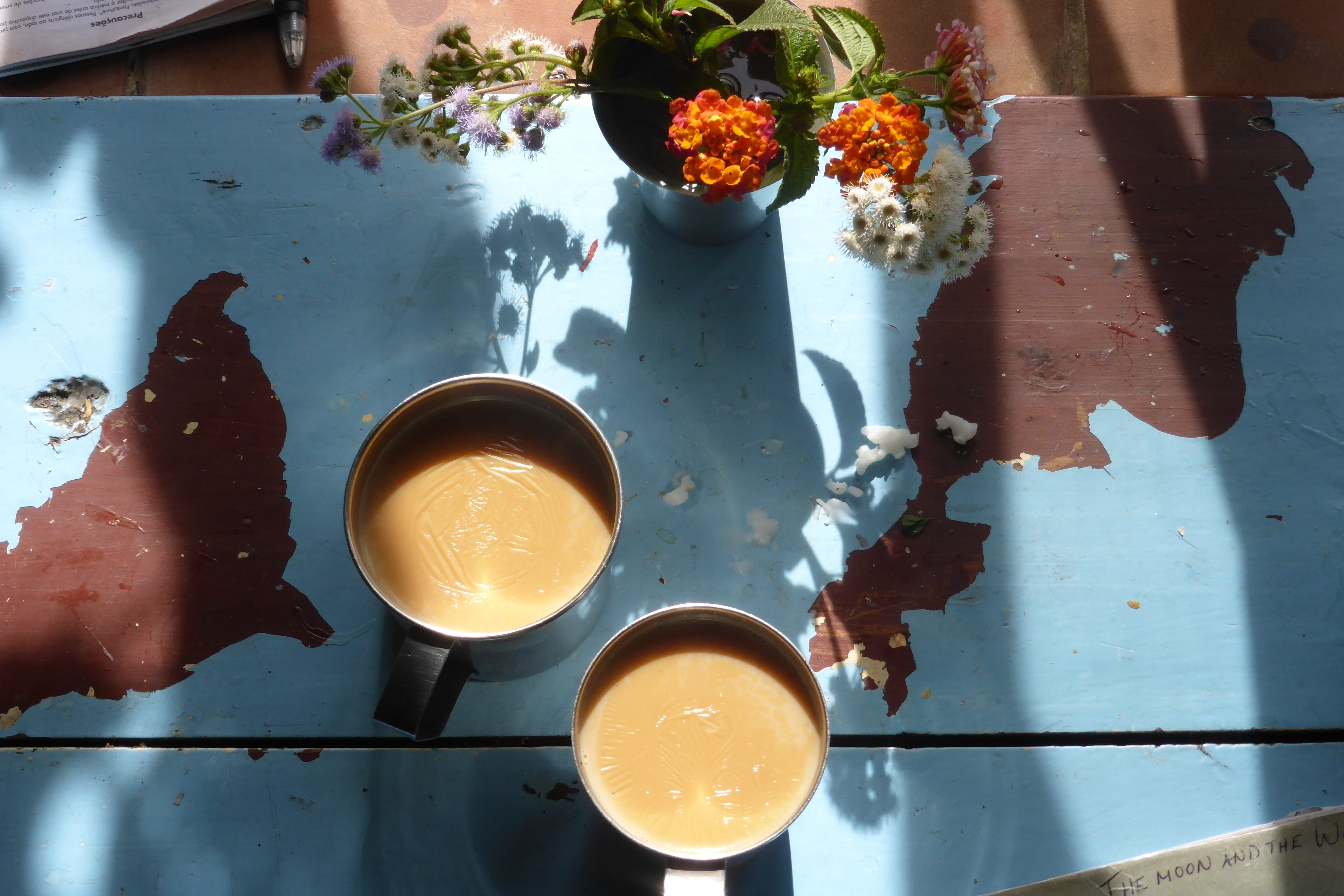
Beach House Chai in Tamil Nadu

Beach House Chai on Karuna Farm, Tamil Nadu

This is something we quaff every day; with some sitar int he background and little incense waft, we could be back in Tamil Nadu, in our cottage on the hills (we have a thing for cottages on hills!!!!)

The ceremony of chai, the aroma as it bubbles on the stove, makes us both feel so at home. Its up there with the smell of freshly baked bread or sweet peas in the depth of summer.

A simple everyday chai here that adds spice and warmth to your morning cuppa. You may like it milkier, adjust the water to milk ratio as you like.  Namastex

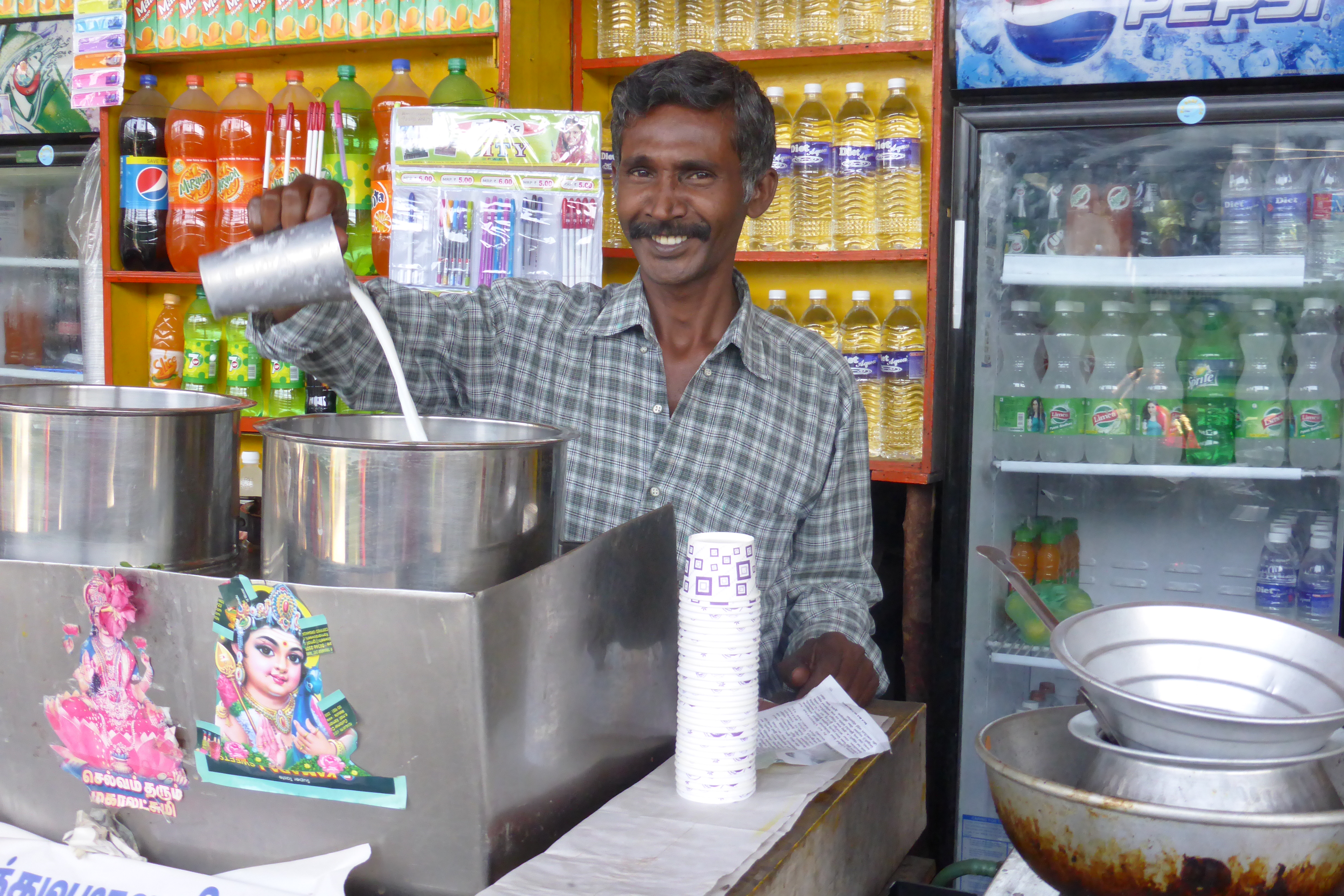
Happy Chai Man, Madurai '14

Happy Chai Man, Madurai ’14

The Bits – 4-6 cups

1.5 ltrs filtered water

500ml almond/ soya milk (unsweetened)

12 green cardamom pods
2 inch piece of fresh ginger
1 cinnamon stick (3 inches, broken in two)
2 star anise

4 teas loose leaf tea (assam is best or 4 normal tea bags ripped open)
jaggery or unrefined brown sugar (to taste)

Do It
Grab a large saucepan. Boil the water in a kettle (quicker) or bring to a boil in the sauce pan.

In a pestle and mortar, bash up the cinnamon and star anise, add to the boiling water, then bash up the cardamom and cinnamon, add that to the boiling water. Lower heat to a simmer and cover, leave to infuse for 20 minutes.

Now, bring back to a rolling boil, spoon in the tea. Leave to bubble away for a couple of minutes and then add your milk. Bring back to a boil and sweeten as you prefer. Indians love it very sweet indeed.  Using a sieve (and a ladle is easiest), pour into your favoured receptacle.

Serve

In your finest cups. Smaller cups are better and more authentic, even a small glass will do (generally how its served in a proper Chai stall). Sip and slurp with relish.


Foodie Fact – Cinnamon

Surely one of the worlds coolest barks!  Cinnamon is medicine. Powerful agent for healing.  There are two main types of Cinnamon that we can buy, Chinese (known as Cassia) and Ceylon(which is harder to find and supposedly more refined), it is one of the oldest spices we know of and was used by the ancient Egyptians as medicine and also for embalming!  It was considered more precious than gold.  It was even mentioned in Chinese botanical medicine over 4700 years ago.

Containing some truly magical essential oils, cinnamon is a potent anti-inflammatory, anti microbial (cinnamon essential oil can be used as a powerful preservative), flavouring high carb food with cinnamon slows the release of sugars into the blood stream,  helps with type-2 diabetes, it is a very, very, very strong anti-oxidant.  Even smelling the scent of cinnamon has been shown to boost brain activity.   It is also an excellent source of fibre, calcium and manganese.

Cinnamon has long be regarded as a warming spice in Chinese and Indian energy based medicine systems.  This means that is you feel a cold coming on drink plenty of cinnamon, ginger and lemon tea and you’ll be fine!!!

Cinnamon is best bought in stick form, it stores well for an age.  You can then crush it or grind it up freshly ans savour that familiar aroma.  Once crushed, kept it in a sealed container out of natural sunlight.  A fridge is best (this goes for all spices).

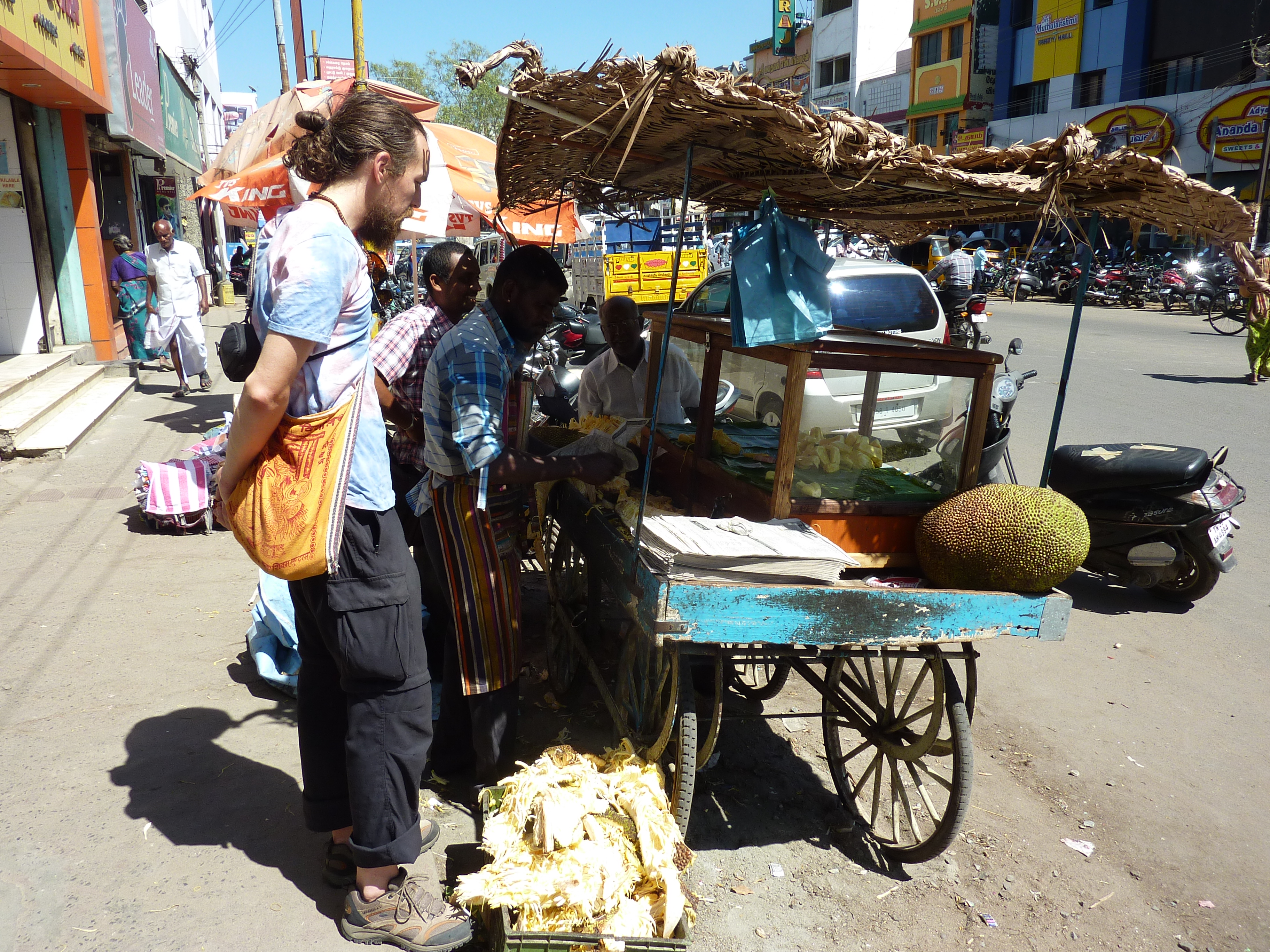
Chai's off the menu for me, I hit the Jack Fruit stand instead.  Yum!

Chai’s off the menu for me in India, I hit the Jack Fruit stand instead. Yum!

Or

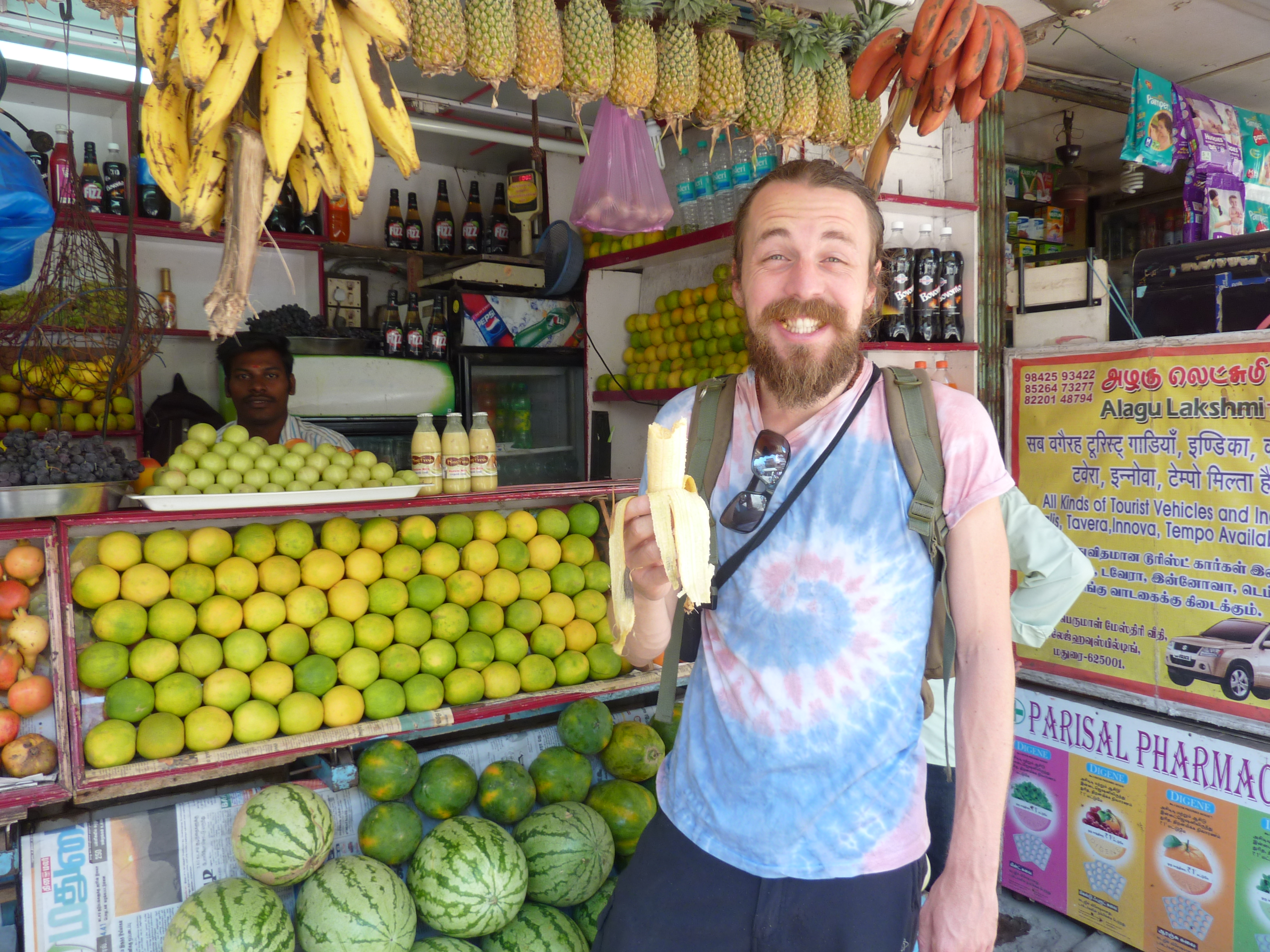
Or a banana....

 Banana!!!!!

Categories: Healing foods, Infusions, Recipes | Tags: , , , , , , , , , , | 12 Comments

Inspiring Vegan Quotes (pt 1)

Hello Lovely Ones,

We normally let the food do the talking, but have been reading into veganism of late and unearthing some real pearls of inspirational wisdom.  We thought you might like them too.  Here we present a selection of our favorites (part one of a two part series!)  

Sometimes a good quote can really focus your mind on an issue, another persons voice, a like minded echo, can cast new light and energy.  These assembled quotes will be made into the new B.H.K. page ‘Inspiration Library’  (see above).  We hope you find them as challenging and uplifting as we did and that the message of peace to all beings rings true, far and wide.

Lee and JaneXXXXXXX 

“The greatness of a nation and its moral progress can be judged by the way its animals are treated.”

“In matters of conscience the law of majority has no place.”

“Earth provides enough to satisfy every man’s need, but not every man’s greed.”

“You must be the change you wish to see in the world.”

“I hold that the more helpless a creature, the more entitled it is to protection by man from the cruelty of man”  Mahatma Gandhi

“One should not kill a living being, nor cause it to be killed, nor should one incite another to kill. Do not injure any being, either strong or weak, in the world.” Buddha

“Let food be thy medicine.”  Hippocrates

“The Gods created certain kinds of beings to replenish our bodies; they are the trees and the plants and the seeds.” Plato

“Isn’t man an amazing animal? He kills wildlife – birds, kangaroos, deer, all kinds of cats, coyotes, beavers, groundhogs, mice, foxes and dingoes – by the million in order to protect his domestic animals and their feed. Then he kills domestic animals by the billion and eats them. This in turn kills man by the million, because eating all those animals leads to degenerative – and fatal- health conditions like heart disease, kidney disease, and cancer. So then man tortures and kills millions more animals to look for cures for these diseases. Elsewhere, millions of other human beings are being killed by hunger and malnutrition because food they could eat is being used to fatten domestic animals. Meanwhile, some people are dying of sad laughter at the absurdity of man, who kills so easily and so violently, and once a year, sends out cards praying for “Peace on Earth.” – from Old MacDonald’s Factory Farm by C. David Coats

“The torch of love is lit in the kitchen.”  Author Unknown

“There is no fundamental difference between man and animals in their ability to feel pleasure and pain, happiness, and misery.” Charles Darwin

“Non-injury to all living beings is the only religion.” (first truth of Jainism) “In happiness and suffering, in joy and grief, we should regard all creatures as we regard our own self, and should therefore refrain from inflicting upon others such injury as would appear undesirable to us if inflicted upon ourselves.” “This is the quintessence of wisdom; not to kill anything. All breathing, existing, living sentient creatures should not be slain, nor treated with violence, nor abused, nor tormented, nor driven away. This is the pure unchangeable Law. Therefore, cease to injure living things.” “All living things love their life, desire pleasure and do not like pain; they dislike any injury to themselves; everybody is desirous of life and to every being, his life is very dear.”
Yogashastra (Jain Scripture) (c. 500 BCE)”

“I became convinced that noncooperation with evil is as much a moral obligation as is cooperation with good.”

Martin Luther King Jr.


“The worst sin toward our fellow creatures is not to hate them, but to be indifferent to them: that’s the essence of inhumanity.” George Bernard Shaw

“Let us remember that animals are not mere resources for human consumption. They are splendid beings in their own right, who have evolved alongside us as co-inheritors of all the beauty and abundance of life on this planet”  Marc Bekoff

“150 years ago, they would have thought you were absurd if you advocated for the end of slavery. 100 years ago, they would have laughed at you for suggesting that women should have the right to vote. 50 years ago, they would object to the idea of African Americans receiving equal rights under the law. 25 years ago they would have called you a pervert if you advocated for gay rights. They laugh at us now for suggesting that animal slavery be ended. Some day they won’t be laughing.” Gary Smith

“People often say that humans have always eaten animals, as if this is a justification for continuing to the practice. According to this logic, we should not try to prevent people from murdering other people, since this has also been done since the earliest of times” Isaac Bashevis Singer

“Most people would say they love animals, but the reality is, if your using animals for food, clothing, or entertainment, you’re only considering the lives of certain animals, typically those of cats and dogs.” Melisser Elliott

“Let us not look back in anger, or forward in fear, but around us in awareness.” James Thurber

“Make ethical choices in what we buy, do, and watch. In a consumer-driven society our individual choices, used collectively for the good of animals and nature, can change the world faster than laws.” Marc Bekoff

“Not to hurt our humble brethren (the animals) is our first duty to them, but to stop there is not enough. We have a higher mission – to be of service to them whenever they require it… If you have men who will exclude any of God’s creatures from the shelter of compassion and pity, you will have men who will deal likewise with their fellow men.” St Francis of Assisi

“We consume the carcasses of creatures of like appetites, passions and organs with our own, and fill the slaughterhouses daily with screams of pain and fear.” Robert Louis Stevenson

“Ethics, too, are nothing but reverence for life. That is what gives me the fundamental principle of morality, namely, that good consists in maintaining, promoting, and enhancing life, and that destroying, injuring, and limiting life are evil.” Albert Schweitzer

“May our daily choices be a reflection of our deepest values, and may we use our voices to speak for those who need us most, those who have no voice, those who have no choice.” Colleen Patrick-Goudreau

“If you are a feminist and are not a vegan, you are ignoring the exploitation of female nonhumans and the commodification of their reproductive processes, as well as the destruction of their relationship with their babies;

If you are an environmentalist and not a vegan, you are ignoring the undeniable fact that animal agriculture is an ecological disaster;

If you embrace nonviolence but are not a vegan, then words of nonviolence come out of your mouth as the products of torture and death go into it;

If you claim to love animals but you are eating them or products made from them, or otherwise consuming them, you see loving as consistent with harming that which you claim to love.

Stop trying to make excuses. There are no good ones to make. Go vegan.”  Gary L. Francione

“Have a mouth as sharp as a dagger, but a heart as soft as tofu.”  Chinese proverb


“I am only one, but I am one. I cannot do everything, but I can do something. And I will not let what I cannot do interfere with what I can do.” Edward Everett Hale

“Society does not want individuals that are alert, keen, revolutionary, because such individuals will not fit into the established social pattern and they may break it up. That is why society seeks to hold your mind in its pattern and why your so called education encourages you to imitate, to follow, to conform” Krishnamurti

“We all love animals. Why do we call some ‘pets’ and others ‘dinner?’” K.D. Lang

“Nothing will benefit human health and increase the chances of survival of life on Earth as much as the evolution to a vegetarian diet.”

“It is my view that the vegetarian manner of living, by its purely physical effect on the human temperament, would most beneficially influence the lot of mankind.”

Albert Einstein

“The question is not, ‘Can they reason?’ nor, ‘Can they talk?’ but rather, ‘Can they suffer?’ Jeremy Bentham

“In fact, if one person is unkind to an animal it is considered to be cruelty, but where a lot of people are unkind to animals, especially in the name of commerce, the cruelty is condoned and, once large sums of money are at stake, will be defended to the last by otherwise intelligent people.”  Ruth HarrisonAnimal Machines

“I am in favour of animal rights as well as human rights.  That is the way of a whole human being.”  Abraham Lincoln

”Non-violence leads to the highest ethics, which is the goal of all evolution.  Until we stop harming all other living beings, we are still savages.”  Thomas Edison

“It shouldn’t be the consumer’s responsibility to figure out what’s cruel and what’s kind, what’s environmentally destructive and what’s sustainable. Cruel and destructive food products should be illegal. We don’t need the option of buying children’s toys made with lead paint, or aerosols with chlorofluorocarbons, or medicines with unlabeled side effects. And we don’t need the option of buying factory-farmed animals.” Jonathan Safran

“My body will not be a tomb for other creatures.”  Leonardo Da Vinci

“Of all the creatures, man is the most detestable. Of the entire brood, he’s the one that possesses malice. He is the only creature that inflicts pain for sport, knowing it to be pain. The fact that man knows right from wrong proves his intellectual superiority to the other creatures; but the fact that he can do wrong proves his moral inferiority to any creature that cannot.” Mark Twain

Categories: Inspiration, Vegan | Tags: , , , , , , , , , , , , | 16 Comments

Creamy Broccoli, Sunflower and Lemon Dip

Broccoli, Sunflower and Lemon Dip

Broccoli, Sunflower and Lemon Dip

Fancy a quick dip!  This simple, creamy vegan dip is a great way to get more broccoli into our lives.  Which is never a bad thing!

Broccoli is one of the healthiest things sprouting from the earth.  Outrageously high in vitamin C and K.  Broccoli should not be cut before storing, otherwise the vitamin content decreases and should not be washed before popping in the fridge (a general rule with all fruit and veg) as this speeds up the spoiling process.

The nutrients in vegetables and fruits is directly effected by the soil and methods used in growing.  Organic is best, but even modern organic, industrialised practices leads to an depletion in the nutrients in soil and  subsequently the things grown in it.  In the Beach House, we wholeheartedly recommend befriending local producers/ farmers or even better growing your own.

This went down a treat at lunchtime today, perfect summer dipping fodder with the added benefit of being super healthy and light.

The Bits – Males one bowlful

300g silken tofu

2 handfuls sunflower seeds (soaked overnight = smooth dip, unsoaked = crunchy dip)

1 small head of broccoli (finely chopped)

1 small clove garlic (peeled and crushed)

1/2 lemon (juice and zest)

1/2 handful of fresh dill

1/2 handful of mint leaves

1 tbs good olive oil

Cracked pepper and sea salt (to taste)

Do It

Place all in a food processor and blend for a minute, scraping the sides down if you need to.   If you have used unsoaked seeds, expect a nice crunch to your dip, otherwise, make it nice and smooth.

Beach House radishes - ready for dipping action

Beach House radishes – ready for dipping action

Serve

With all your favourite crudites, we love to dip oat cakes into ours.

Foodie Fact

By birth, Broccoli is an Italian.  A member of the cabbage family and the green sibling of the cauliflower.  It is never good soggy, steam for 5 minutes max or serve raw.  Broccoli is a meal in itself, use the leaves and stems for different textures.

Broccoli has excellent anti-inflammatory and anti-oxidant properties, especially high in vitamin C.  We regularly add it to morning juices to gives us a gentle kickstart in the right direction.  Broccoli is also outrageously high in fibre, helping fight cholesterol and keeping our digestion ticking over nicely.  This green hero also helps our eyes and repairs our skin.  Only a handful of broccoli per day will have considerable benefits.

Summer time and dippin' is easy.....

Summer time and dippin’ is easy…..

Categories: Nutrition, Recipes, Side Dish, Vegan | Tags: , , , , , , , , , | 3 Comments

Italian Flava! Holiday Snaps of Napoli and the Amalfi Coast

ITALIA!  What a place!  Pizza, scenery, pasta, wonderful people, gelato (for Jane), stunning scenery, espresso, incredible history….so much, a country filled with endless passion for life and bellies filled with wonderful culinary creations.  Here we have just a few of our holiday snaps from June’s trip to Southern Italy.

Jane's first gelato (she was a little pleased) - Napoli

Jane’s first gelato (Pistachio flavour) – Downtown Napoli

We started off in Napoli, hiring a car and camping for most of the time.  We rarely spent two nights in one place as the allure of the open road and the fascinating sights just kept us rolling deeper and deeper into Campania.  Napoli reminds me alot of Latin America, a real vibrancy and chaos, it can be scruffy and awe inspiring  in the same alleyway, it is a hive of creativity, is crammed full of ancient historical sights and offers all the opportunity to feast like a greedy baron.

Pizza is the mainstay of things and the Marinara (just tomato sauce, a little garlic and a drizzle of olive oil, so called because the fishermen used to eat it) took dough discs to a whole new level in my eyes.  The wine was local, with a vast array of indigenous grape varieties and generally, delicious.  Apart from eating and sipping coffee with jumpers tied around our necks, we walked the cities old town, took in as many museums, cathedrals, underground grotto’s, gelaterias (Jane) and Greek sculptures as our mortal legs could manage.  Napoli is my new favourite city at a canter.

On the road lunch - Graveyard, somewhere in the Cilento National Park, Campania

On the road lunch, Italy=best produce ever! – In an old graveyard, somewhere in the Cilento National Park, Campania

The spectacular Duomo Cathedral - Napoli

The spectacular Duomo Cathedral – Napoli

After Napoli, and the utterly mental driving conditions (most of the cars bear the scars of the outrageously tight roads and kamikaze scooters), we drove south past Mount Versuvius (the once mighty eruptor) and headed to the Amalfi coast, a place constantly banged on about as being rather pleasant.  Well it was in a  fashion, if you are of the manicured tourist variety.  We are not.  So camped in forests when we could and only ventured into the pretty towns for dinner, which was almost always, fresh, local, seasonal, made my mama and utterly delicious. We generally found things quite cheap, making our breakfast and lunch on roadsides and picnic benches along the way with some of the best fruit and veg I have ever encountered.  Believe the hype!  Italian lemons, plums, tomatoes, olives……the list goes on, are touched with something intangible and utterly magnificent.  Food here is a way of life, a cornerstone of culture…..I have heard this all before, but to witness it first hand and even better, to taste the fruits of this fascination and tradition, made me feel like the luckiest muncher on the Med.

Temple of Poseidon - The Ancient City of Paestum (600BC!), Campania

Temple of Poseidon – The Ancient City of Paestum (600BC!), Campania

Camping by churches seemed to work well - Cilento National Park, Campania

Camping by abandoned churches works well –  Near Morigerati, Cilento National Park, Campania

We found some beautiful camp spots and used disused churchyards regularly.  Almost painfully romantic and with the added bonus of clean water springs to do the washing up and for the occasional bathe.  The weather was sweltering, so we rose early with the sun and generally bedded down under clear night skies, sparkling with stars and fireflies.

The awesome Hercules - National Museum, Napoli

The ancient and mighty Faranese Hercules 3AD (roughly 12 metres tall!) – National Museum, Napoli

Packing up one of our favourite campspots  - Overlooking Positano, Amalfi Coast

Packing up one of our favourite campspots – Overlooking Positano, Amalfi Coast

Stunning villages abound! - Morigerati, Cilento National Park

Stunning villages abound! – Morigerati, Cilento National Park

The national park, Cilento was a real highlight.  The second largest in all of Italy, with little villages on crags, waterfalls, endless forests and some stunning mountainous peaks, far too much to explore in the little time we had.  There seemed to be no one there and the towns were always sleepy and friendly, generally the opposite of the Amalfi coast towns which were packed full of tourists and establishments fixed to empty their pockets of silver.   We discovered a few gems on what is a dramatically beautiful, steep slope, but generally the Amalfi is a little overrated.  Its a big world, many coastlines, why should we all gather in one place?  I have to admire the marketing job done by the tourism folk, Sorrento for example is heaving with Americans who have flown all this way to the Med to see a sanitised version of what is surely, one of the worlds most stunning areas.  And, it was 45 euros for a dorm bed!  45 euros for a wonky bunk!!!!!!

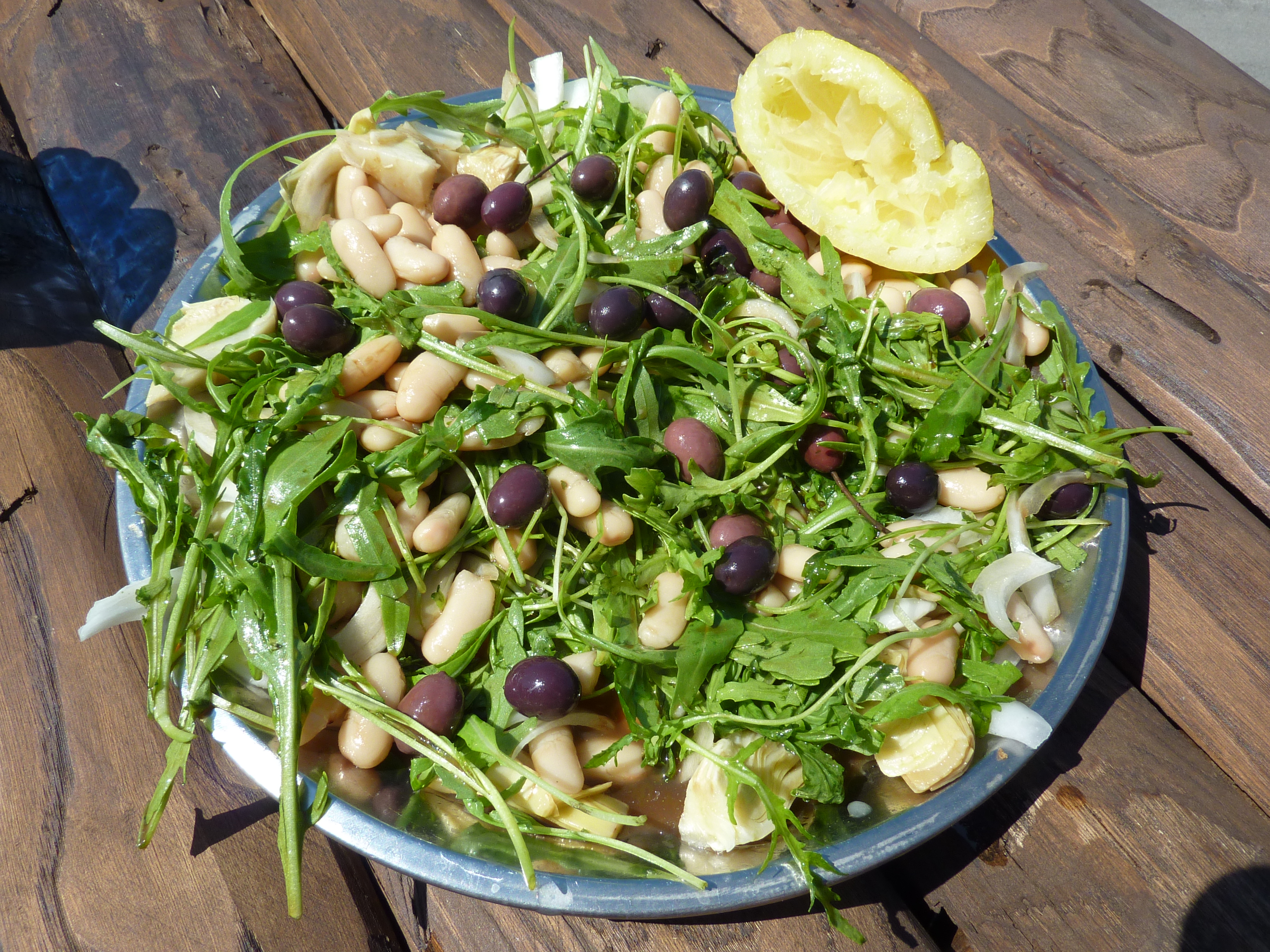
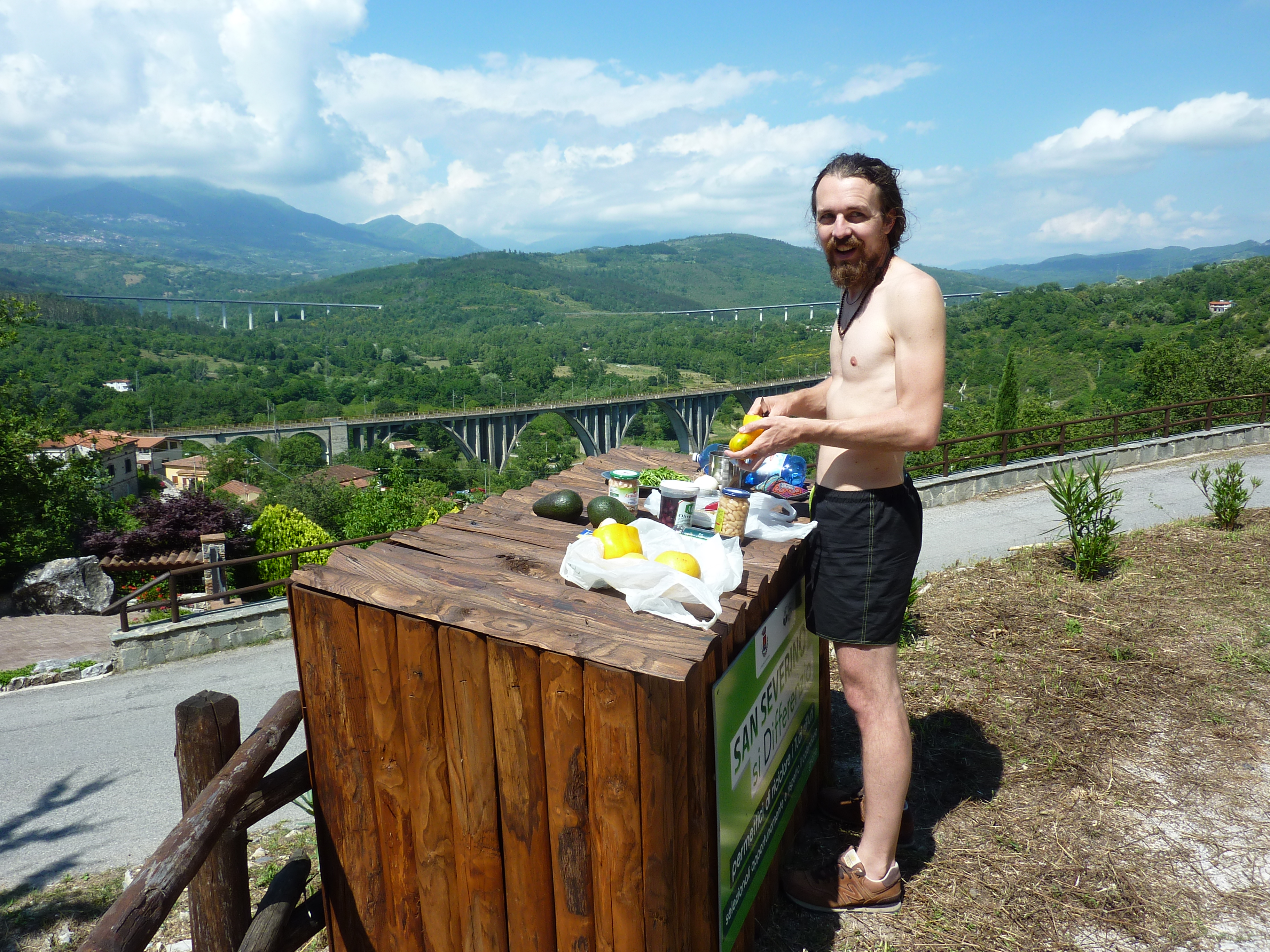
Making salads on bins - A little medieval village, somewhere in the Cilento National Park

Roadside salads – A little medieval village, somewhere in the Cilento National Park


Stunning nature - Cilento National Park

Stunning nature – Cilento National Park

Jane just before another amazing dinner - Campania

Jane just before another amazing dinner – Castellabate, Campania

We spent a week in Cilento National Park, driving the crumbling roads and marvelling at the sheer natural beauty of the place.  It seemed impossible to escape the ancient past as we randomly came across site after site filled with magnificent ruins of towns and temples, the most impressive of which were (of course) Pompei and Paestum.  Some of the details that have survived are stunning, it feels like you’re looking directly into the lives of the people who lived more than 2000 years ago.  We know their names, how much they earned and where they worked, the Gods they worshiped, what they did for giggles and even their favourite snack bars!  These incredibly preserved relics give colour and texture to the ancient world and open fascinating windows into how our forefathers and mothers would have passed their lives.  It wasn’t all good, being a gladiator fighting lions seemed like a raw deal but I have to say, in the most part, they seemed to live well and in a highly advanced, organised and cosmopolitan way.

Another lunch stop, abandon churches again (always with handy fresh water springs for washing up!) - Cilento National Park, Campania

Another lunch stop, abandon churches again (always with handy fresh water springs for washing up!) – Cilento National Park, Campania

Italian beaches are strange and normally filled with sun loungers, costing an exorbitant amount of euros to perch on.  It is the only place in the world I have visited where beaches are private and fenced off!  You need to buy a Cappucino to take a dip in the ocean!  What a strange approach.  Due to this, we only spent 20 minutes on the beach, it all seemed a little hectic and the opposite of relaxing.

Temple of Isis, Pompeii

Temple of Isis, Pompeii

The best pizza in town (gypsy guitarists just out of picture) - Di Mateos, Napoli

The best pizza in town (gypsy guitarists just out of picture) – Di Mateos, Napoli

There are a few famous and touristy pizza restaurants in Napoli, but we were assured by locals that Di Mateos was the best.  Located on Via Tribuani, one of the main streets in the old town, it is always packed full and has a real buzz about it.   It was, without any peer, the best pizza I ever met.  Add to that the band of gypsy’s (not the Jimi Hendrix lot) playing as we went in and you have the full package.  You cannot beat the sound of a well strummed mandolin and some toothless yelping.  It stirs the appetite and soul.

Our favourite dinner spot, in a cave! - Nochelle, Amalfi

Our favourite dinner spot, in a cave! – Nochelle, Amalfi

After all that driving, we landed in Pompeii, not a bad little town considering the daily influx of tourist coaches.  We camped there in a little family ran site and walked the 20 metres to the main gates.  Italy really impressed me in the fact that corporations don’t seem to have taken hold.  Family ran joints, hotels, cafes, restaurants etc seem to be very much the done thing and it adds so much variety and authenticity to towns.  You get to meet the real locals, eat their food, hear their gossip and understand a little about what is actually going on.  Places ran by people who genuinely care about what they’re doing which makes all the difference.  I hear this does not extend to Italian politics, but that’s a whole different blog……

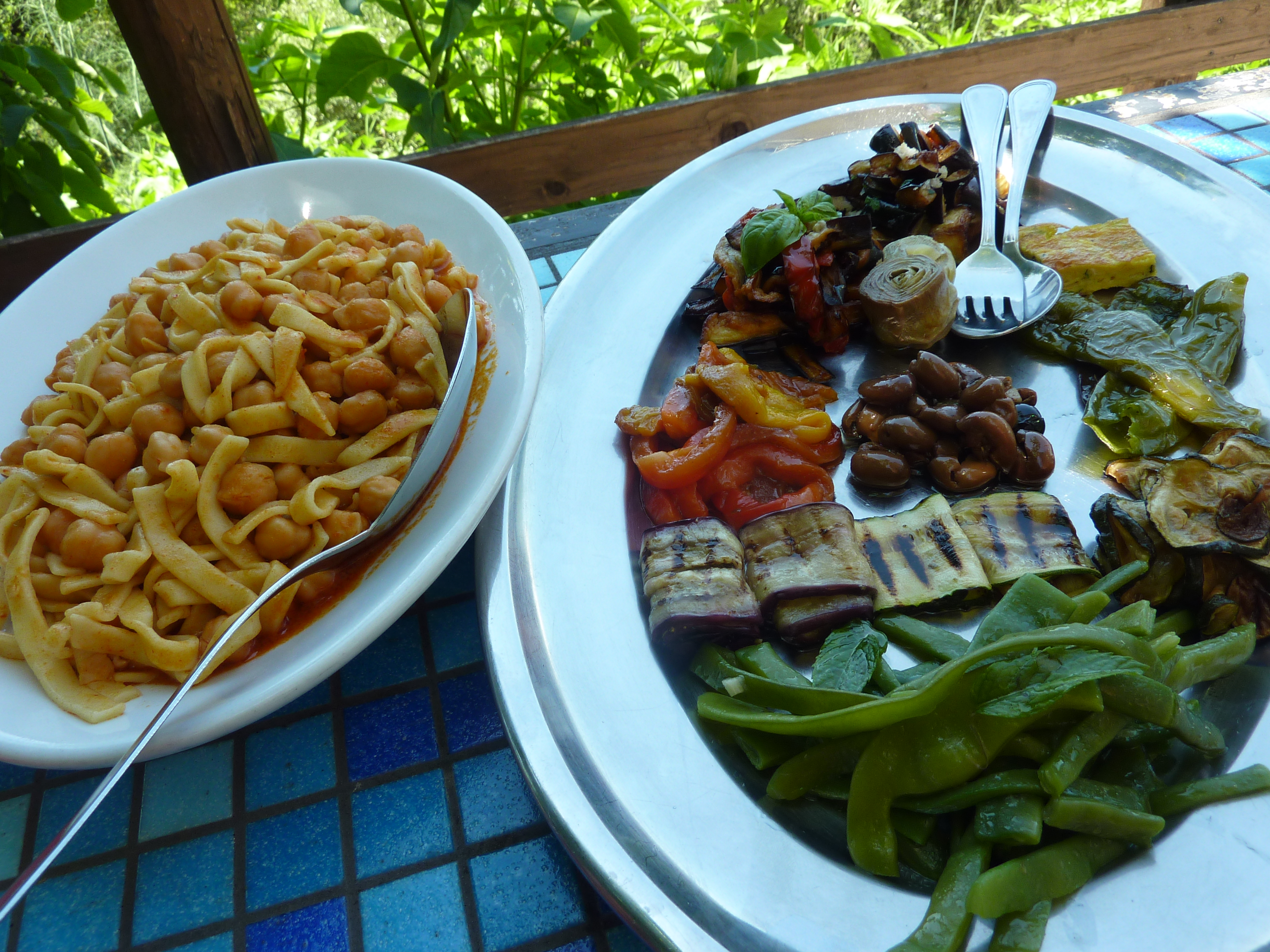
Last but certainly not least, antipasti and pasta! - Mama made it, Morigerati, Campania

Last but certainly not least, antipasti and pasta! – Mama made it, Morigerati, Campania

So Italy is nice, very highly reccomended by the B.H.K.  There seems so much to rave about but its the warmth and intensity of the locals which will stay with me.  Prego!!!!  I think Jane and I would go back now, if we weren’t tending to tomatoes and reveling in the unpredictable beauty of a Welsh summer in full swing.

Categories: Travel | Tags: , , , , , , , , , , , , | 8 Comments

Raw Food vs Cooked Food and The Power of Enzymes

Jane and I are very conscious of the power and cleansing attributes of a full-on raw food diet.  We have tried it out for the past two years for at least a month (normally stretching to two) and have felt amazing; energy levels through the roof, body and mind happy and content…..  Coupled with no alcohol, gluten or caffeine we were incredibly virtuous for a while and (almost) literally floated around in a state of exalted well-being.  It was nice.  We became converts by going through the process of learning to be more experimental with raw produce and the latent potential of the humble nut.  See more of our writing on the topic here Why Raw Food?  and more and even a little more (Raw Earth Month – Moving Back to Nature) for good measure.
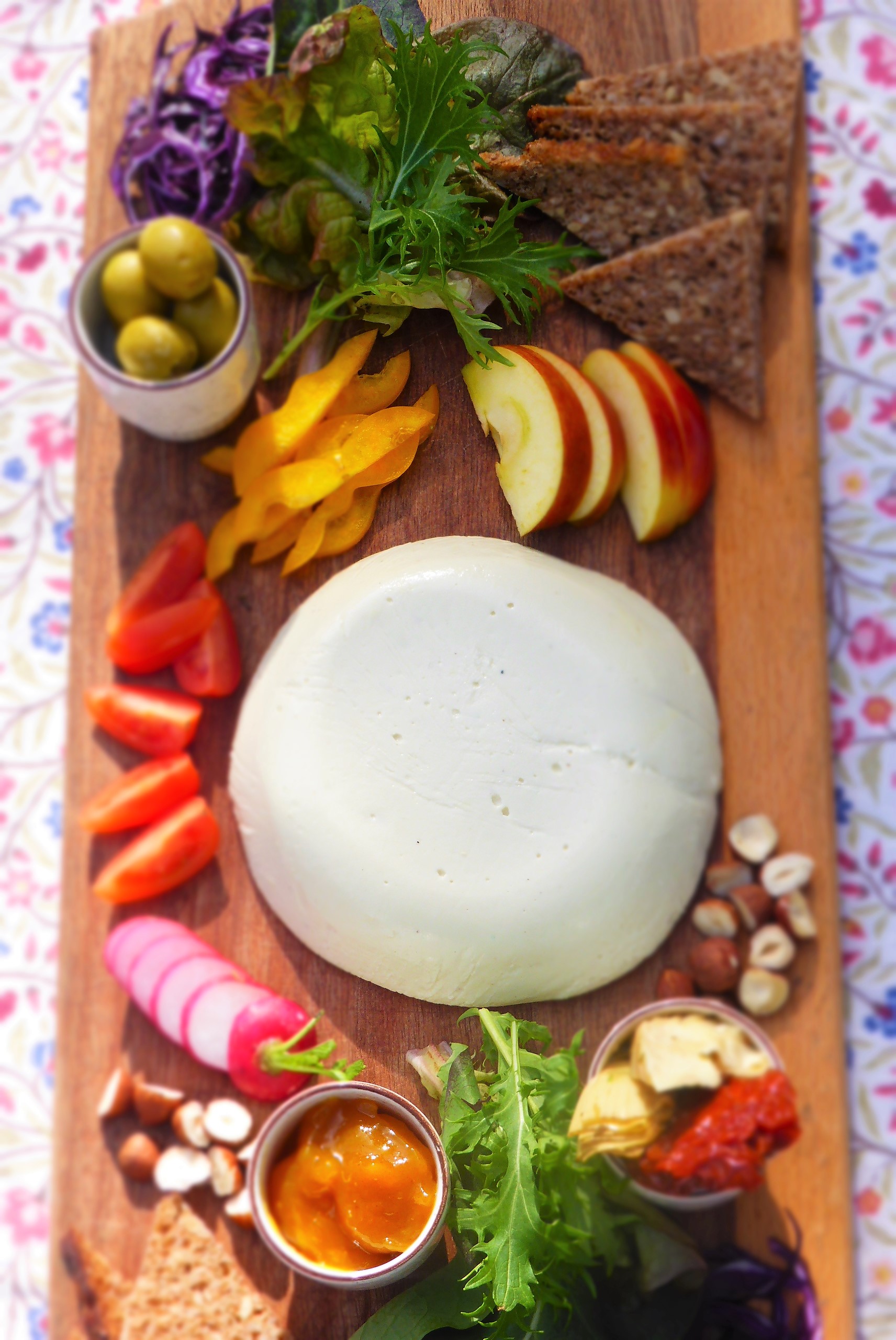
The raw food movement does seem to attract a certain amount of food extremists, which puts alot of folk off.  Its not all about being super skinny and living a veg obsessed, semi monastic existence.  Jane and I do not fall into this bracket, we just love to experiment with foods and our bodies and really get a buzz from succulent, vibrant raw food dished.  Check it out!
The desserts are something truly heavenly, Raw Chocolate Brownie with Chocolate Icing  or Raw Coconut and Lime Cheesecake.  Even the inventive way that salads are used is something to get the taste buds whirling, think Sprouted Wheat Grain, Apple and Mustard Salad or how about a Crunchy Thai Salad with Green Coco Dressing?  OK, now I’m on a roll, how about a Raw Lasagne with Avocado and Lemon Ricotta?  In fact its probably best just to check out our Raw button in the tags section (top right of the page)….
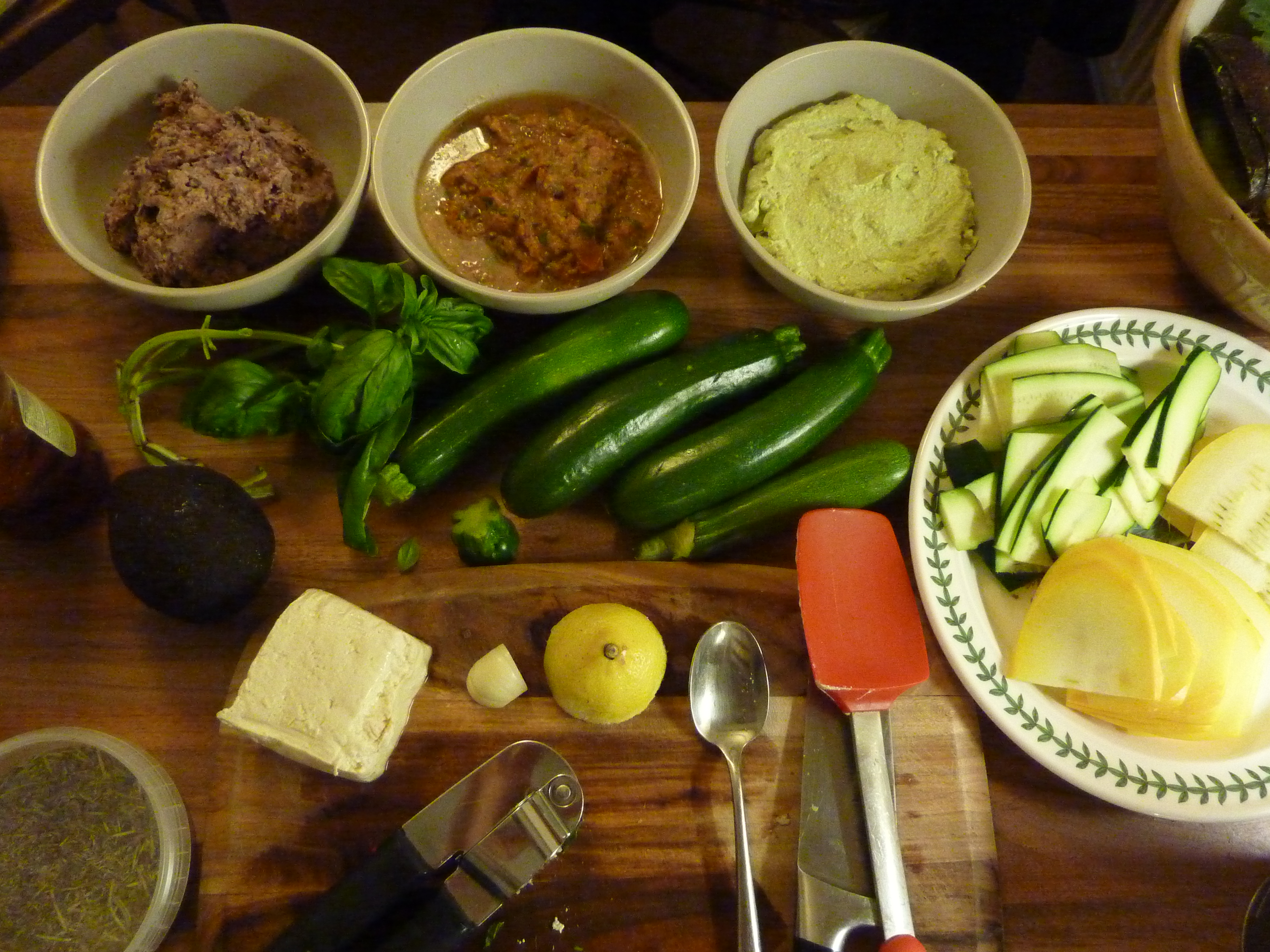
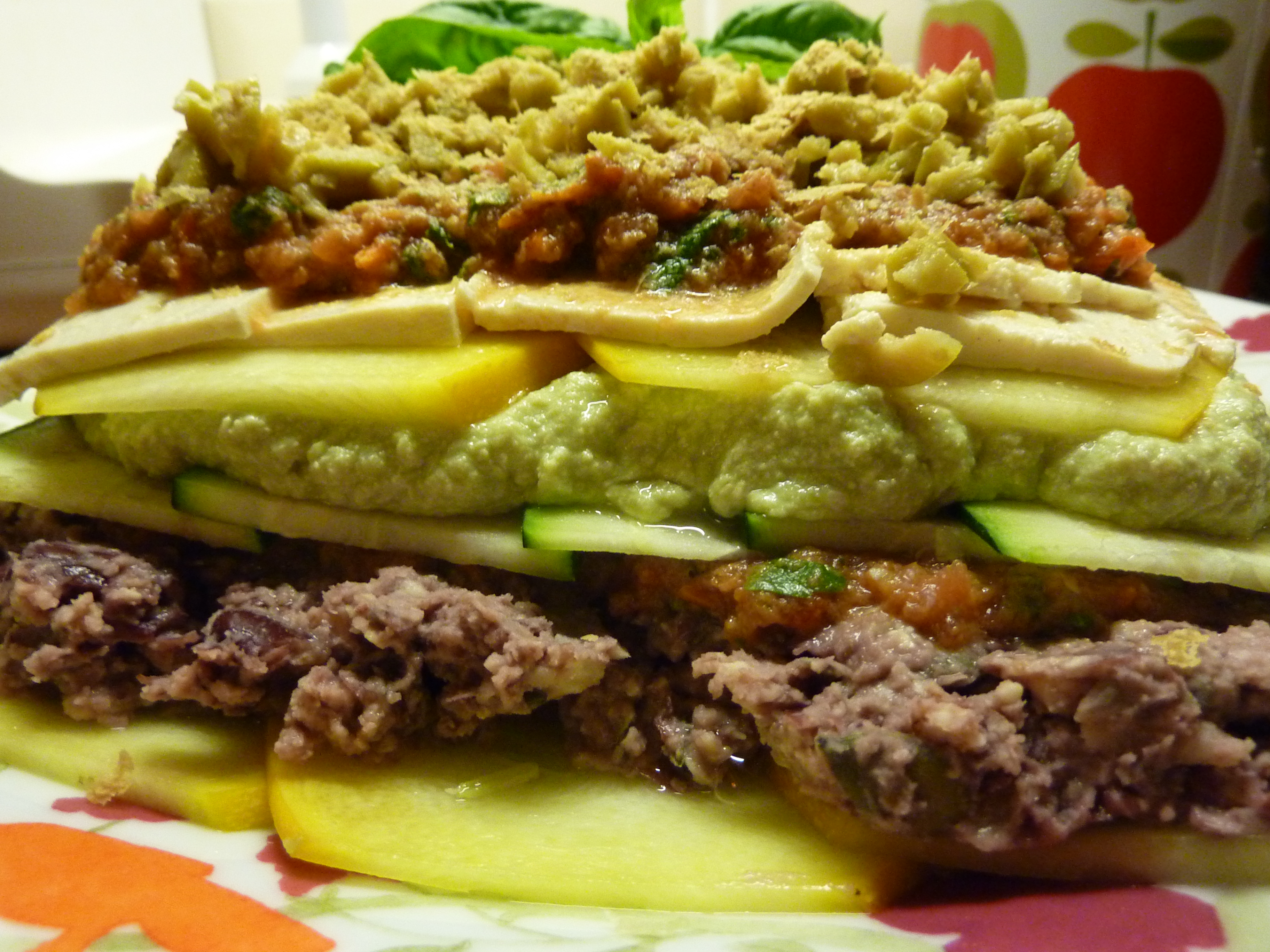
Raw Vegan Lasage with Avocado and Lemon Ricotta

Raw – Vegan Golden Courgette Lasagna with Avocado and Lemon Ricotta

RAW FOOD VS COOKED FOOD

So the food can be inspiring and creative, but what about the health side of things.  Most fruits and veggies are best served raw, but those containing lycopene (tomatoes, red pepper and other reddish fruits and veg like watermelons, red guava etc) are best served, from a nutritional point of view, slightly cooked.  Lycopene is a very potent antioxidant.  When cooked, tomatoes for example, show a boost in lycopene levels.  The drawback however, and this goes for most vegetation, is that when cooked for lets say 30 minutes, the Vitamin C levels of tomatoes decreases by 30%.  Basically heat increases the rate of degradation of food or ‘oxidisation’, which is bad for foods and bad for our bodies (hence the name ‘anti-oxidants’ which help against it).  Boiling foods results in loss of valuable nutrients which leech into the water (more reasons to use it as soup stock!?)  The healthiest way to cook food is to gently steam them and not to overcook them.  Firm is fine.  This will preserve much of their nutritional value.

So its a bit of a balancing act really, gain lycopene and lose Vitamin C.  Some people say that Vitamin C is more prevalent in the plant world and we are better served to boost the lycopene levels, which is rarer.  ‘Raw food vs Cooked Food’ is a complex comparison and I’d say that mostly raw is best for optimum health (if that’s what you’re driving at).  We are still not sure of all of the benefits of raw food, but each year, science is discovering more reasons to get excited about salads and carrot batons!!!!!

Oven Baked Summer Squash filled with Buckwheat, Beetroot and Walnuts

Cooked – Oven Baked Summer Squash filled with Buckwheat, Beetroot and Smoked Tofu

Here is an interesting article I just read about the importance of enzymes to overall health, our bodies cannot thrive without them!

Importance of Enzymes

Enzymes are the sparks that start the essential chemical reactions our bodies need to live. They are necessary for digesting food, for stimulating the brain, for providing cellular energy, and for repairing all tissues, organs, and cells. Humbart Santillo, in his book, Food Enzymes, quotes a Scottish medical journal that says it well: “Each of us, as with all living organisms, could be regarded as an orderly, integrated succession of enzyme reactions.”

There are three types of enzymes: metabolic enzymes, digestive enzymes, and food enzymes.

Metabolic enzymes catalyze, or spark, the reactions within the cells. The body’s organs, tissues, and cells are run by metabolic enzymes. Without them our bodies would not work. Among their chores are helping to turn phosphorus into bone, attaching iron to our red blood cells, healing wounds, thinking, and making a heart beat.

Digestive enzymes break down foods, allowing their nutrients to be absorbed into the bloodstream and used in body functions. Digestive enzymes ensure that we get the greatest possible nutritional value from foods.

Food enzymes are enzymes supplied to us through the foods we eat. Nature has placed them there to aid in our digestion of foods. This way, we do not use as many of the body’s “in-house” enzymes in the digestive process.

This is important to remember. Dr. Edward Howell, who has written two books on enzymes, theorizes that humans are given a limited supply of enzyme energy at birth, and that it is up to us to replenish our supply of enzymes to ensure that their vital jobs get done. If we don’t replenish our supply, we run the risk of ill health.

In the Enzyme Nutrition axiom, Howell postulates that “The length of life is inversely proportional to the rate of exhaustion of the enzyme potential of an organism. The increased use of food enzymes promotes a decreased rate of exhaustion of the enzyme potential.”

In other words, the more food enzymes you get, the longer, and healthier, you live.

The key is to remember that food enzymes are destroyed at temperatures above 118 F. This means that cooked and processed foods contain few, if any enzymes, and that the typical North American diet is enzyme-deficient. When we eat this type of diet, we could well be eating for a shorter and less-than-healthy life.

This points back to the importance of eating raw fruits and vegetables because they are “live foods”; that is, foods in which the enzymes are active. The more enzymes you get, the healthier you are. And the more raw foods you eat, the more enzymes you get.

DETOXIFICATION

One of the roles of enzymes in the body is detoxification — breaking down toxic substances so that they are excreted and cannot build up to possibly cause harm. Although this is done by metabolic enzymes, research shows that enzymes found in the foods we eat — although not food enzymes — may help our bodies do this.

This has such potential that the U.S. Army is looking into it. The U.S. Army Edgewood Research, Development, and Engineering Center has isolated enzymes that neutralize chemical warfare agents. The center’s Dr. Joseph J. DeFrank believes the enzymes can be used to rapidly decontaminate facilities, equipment, and vehicles.

The Frank M. Raushel Research Group is looking at ways to exploit the properties of enzymes for a variety of chemical and medicinal uses. One project is studying enzymes that catalyze the detoxification of organophosphate insecticides.

Other research points in the same direction. Research at the University of California — Davis is showing that green barley extract may accelerate the body’s breakdown of malathion, an organophosphate insecticide used heavily throughout the world.

Six different experiments measured the ability of barley leaf extract to “detoxify” this insecticide. All revealed positive results.

Interestingly enough, one more test was run after subjecting the green barley extract to high heat. This, the researchers believe, denatured and removed the proteins. Detoxification ability was again measured, and this time, did not take place. This indicates that the detoxifying agent in green barley is an enzyme, and when heated, the enzymes are destroyed. It also points out that green barley extract is “alive” — that is, that the enzymes are intact.

This info taken from the AIM International Partners Magazine, July, 1997


If you fancy trying out a raw food diet, you will find loads of recipes on the B.H.K. and if you need any advice, just drop us a line.  The more raw food you can incorporate into your diet, the better.   With the sun shining on our beautiful little island, I can think of no better time to drop the wok and pick up the grater.  Go Raw!!!!!!(mostly)  But most of all, have fun and enjoy cooking and eating!

Categories: Detox, Healing foods, Raw Food, Vegan | Tags: , , , , , , , | 9 Comments

Jane’s Easy Seeded Wholemeal Loaf

Jane on the beach this morning (Dinas Dinlle)

Jane on the beach this morning (Dinas Dinlle)

Jane has been running wild with the bread vibe recently, all kinds of doughy goodness has been rising and getting crusty around the BHK. The most impressive is the most simple recipe, which is just the way things should be.

Jane has taken a few steps out of your average bread making venture and the result is a light and crispy loaf, with decent density. It makes a great base for regular bread making and avoidance of all that strange stuff made by big supermarkets etc masquerading as bread (when we really know that some strange practices have happened behind the scenes). When you taste good quality, homemade bread, you will not be hurrying back to buy some ‘fly away’ seeded loaf from a luminous aisle. This is the real deal.  You also know what goes into your loaf, there can be some strange things done with wheat, bits taken out then added later, all kinds of additive and preservative action.

Whenever we turn the oven on, we pop a loaf in. It makes sense. Turning the oven on is a real event for us, not only does it heat our kitchen (where we have no heating!!!) it also gets our minds tuned into baked goods. What can we rustle up? Rustling things up is very prevalent in the way we do things over here on Tiger Mountain.

Last year we posted something like a ‘Simple Loaf’ recipe, but this takes things even further in the simplicity stakes. If you know of an easier way to make a decent loaf, please let us know.

Jane and I have both decided that bread is cool. We have tried going off it for lengthy periods, but in moderation, toast is a wonderful thing (especially with loads of Marmite lathered on). I don’t think either of us are gluten intolerant (although we all probably are to one degree or another). I am yet to find a decent gluten free recipe for homemade bread, I’ve tried a few, but many of them contain eggs and there is a limit to the way that silken tofu can substitute the richness and binding properties of an egg. I will keep trying though.

Serving suggestions. You have to love the way that companies incorporate a serving suggestion on most of their processed products. I was looking at a can of beans the other day and it was just a picture of a load of beans, underneath stating ‘serving suggestions’. Serve beans, as beans! Who knew!!!! Serving suggestions here are bowls of soup, try this one, or here’s another beauty or maybe a raw soup would be nice?  You can of course go old school and just toast it up and spread on some bramble jelly of even make a little crostini, with chopped tomatoes, balsamic vinegar and fresh basil or oregano.

Have you tried spelt? This is my new favourite loaf and I will be posting a recipe for my ‘Roman Loaf’ very soon. Spelt has an awesome toasty taste and is filled with nutrition and relaxed gluten. Also barley is ridiculously high in fibre, natures highest in fact and makes for a magic crusty lump.

WHOLEWHEAT OR WHOLEMEAL?

When buying flour, try to get whole meal/ wheat.  Stoneground seems to the the most traditional way of doing things.  Sometimes ‘whole meal’ is not actually ‘whole wheat’ and this can mean a decrease in the nutritional value of your loaf.  These terms change from country to country, but we are looking for wheat with all the bran and germ etc intact and certainly not removed. Some brown looking flours can be mixed with other grains, so its worth checking the ingredients.  Also look for unbleached white flour, as bleach and food just don’t mix.  In fact, bleach and life just don’t mix!  You can easily make this loaf 100% whole wheat and experiment with different types of flour (see above).  The white flour is only really there to make it lighter and tighter (if you catch my drift).  As you all probably know by now, I’m the rough, crusty flapjack side of the ‘Beach House Bakery’ and Jane is the more frilly scone and tinsel approach.  This loaf is a compromise of sorts…..

Over to Jane for the simplicity masterclass:

For one average sized loaf (you know that bread tin shape)

The Bits

500g flour (roughly 300g whole wheat, 200g white)

7g fast action yeast (roughly one sachet)

2 tbsp olive oil

1 tbsp brown rice extract or barley malt extract

1 big handful of seeds (sunflower, hemp, pumpkin, poppy…….mixture of these?)

1 1/4 teas salt


Do It

Mix the flour, salt and yeast in a large bowl with your hands.

Dissolve the oil and sweetener into 300ml luke warm water.  Stir this mixture into the dough.

Bring it together and turn out onto a lightly floured or oiled surface.  Knead well for 5 minutes until the dough is mixed, add the seeds now.  The dough should not be dry, and should still be sticky to the touch.  Roll dough into a fat oval shape.

Pop into a pre-oiled loaf tin and press down into the edges.  Leave in a warm place covered with cling film of a kitchen towel.  After 1 hour the dough should have doubled in size.  Make deep slashed on the top of the loaf with a very sharp knife.

Pre heat oven to 190oC and bake for 30-35 minutes, until dark golden and risen.  Loosen the edges with a spatula or pallet knife and turn out onto a wire rack.  If it is sticking, leave for a few minutes and have a go after its rested.  It will come out!  Tap the bottom of the loaf with your fingers, it will sound pretty much hollow when it is ready.  If it still feels solid and dough-filled, pop it back in for 5-10 minutes.

Leave to cool for 15 minutes before diving in.

Easy Seeded Loaf

Easy Seeded Loaf

Serve

See the ‘serving suggestions’ above.  Bread is of course best munched fresh out of the oven.  We tend to slice up old bread for croutons or crostini and freeze them.  You can do the same with breadcrumbs, which can come in very handy when making vegan bangers or burgers.

Foodie Fact

Wheat actually originates from South Western Asia and humans have been enjoying it for at least 12,000 years (and counting).   We only got it in the West when Columbus came back from his pilfering missions.

When wheat is processed, at least half of the minerals and vitamins are lost.  If we are eating pasta, breads, flours etc that are processed, we are normally getting very little of the good stuff that is present in natural whole wheat.

Wheat in its natural state is a very nutritious grain indeed, with bags of minerals like manganese and magnesium and barrel loads of fibre.   Sourdough breads are normally a better choice if you feel a gluten intolerant, they also boast better nutrition.  Interestingly, even though wheat is one of the fibre powerhouses of nature, raspberries still contain more fibre!!!!  How cool is that!  Maybe we’ll make a raspberry loaf next time……

And finally.....Buster in a box

And finally…..Buster in a box

Categories: Baking, Recipes, Vegan | Tags: , , , , , , , , , | 10 Comments

We’re Back! and India Holiday Snaps

Under the Big Tree - Sivananda Ashram Madurai, 3/14

Under the Big Tree – Sivananda Ashram Madurai, 3/14

We’re back!  In two pieces;  older, wiser and hairier!

North Wales is shining; bee buzzing, flowers swaying, sheep baaaaaa-ing. This is definitetly the home of the B.H.K. Writing the blog from distant shores just seems a little strange, the creative culinary juices just aren’t flowing as deeply as when we’re hanging out up here with the heather.

This blog is such a big part of our life in Wales, so we’re back and ready to get stuck into good mountain living, with some gorgeous nibbles along the way……

There seems far too much water under the bridge to begin to catch up on the last 6 months. I decided to post a few travel pics to get us warmed up and reacquainted again.

I have been busy (even when travelling!) working on another food-related project which I am superbly excited about. More to follow on this soon. (Hopefully that is a decent enough excuse for not posting any news or recipes for a ridiculous length of time.)

Back in the lovely little Beach House, the fire is roaring (in June) and we are both full tilt and ready to get the garden blooming and the hob fully loaded with plenty of wonderful fruit and veggie action and no doubt some pictures of Buster the cat (who came back on our first morning back in the house, it seems we are linked with the little grey furball!).

Jane getting to grips with an onion - Udaipur, 2/14

Jane getting to grips with an onion – Udaipur, 2/14

Very brief catch up of our antics :
– We have been distant for the last 6 months, in Spain and India, spending time in the Himalayas and on a variety of beaches; cooked vegan food on farms, ate papaya straight from the tree, visited many huge desert forts and palaces, lived in huts and buses, hung out with warm tribal folk, learned to count to 10 in Hindi, practiced yoga by the Ganges, woke at 4am to sing songs, realised that there is more to life than chapatis (but not much!), ate our body weight several times over with the complete rainbow spectrum of all things curries, watched endangered rhinos play whilst sitting on a juvenile elephant, celebrated a Gods birthday……….too much. much, much to tell. Here are a few pics (most food related) that tell a better story:

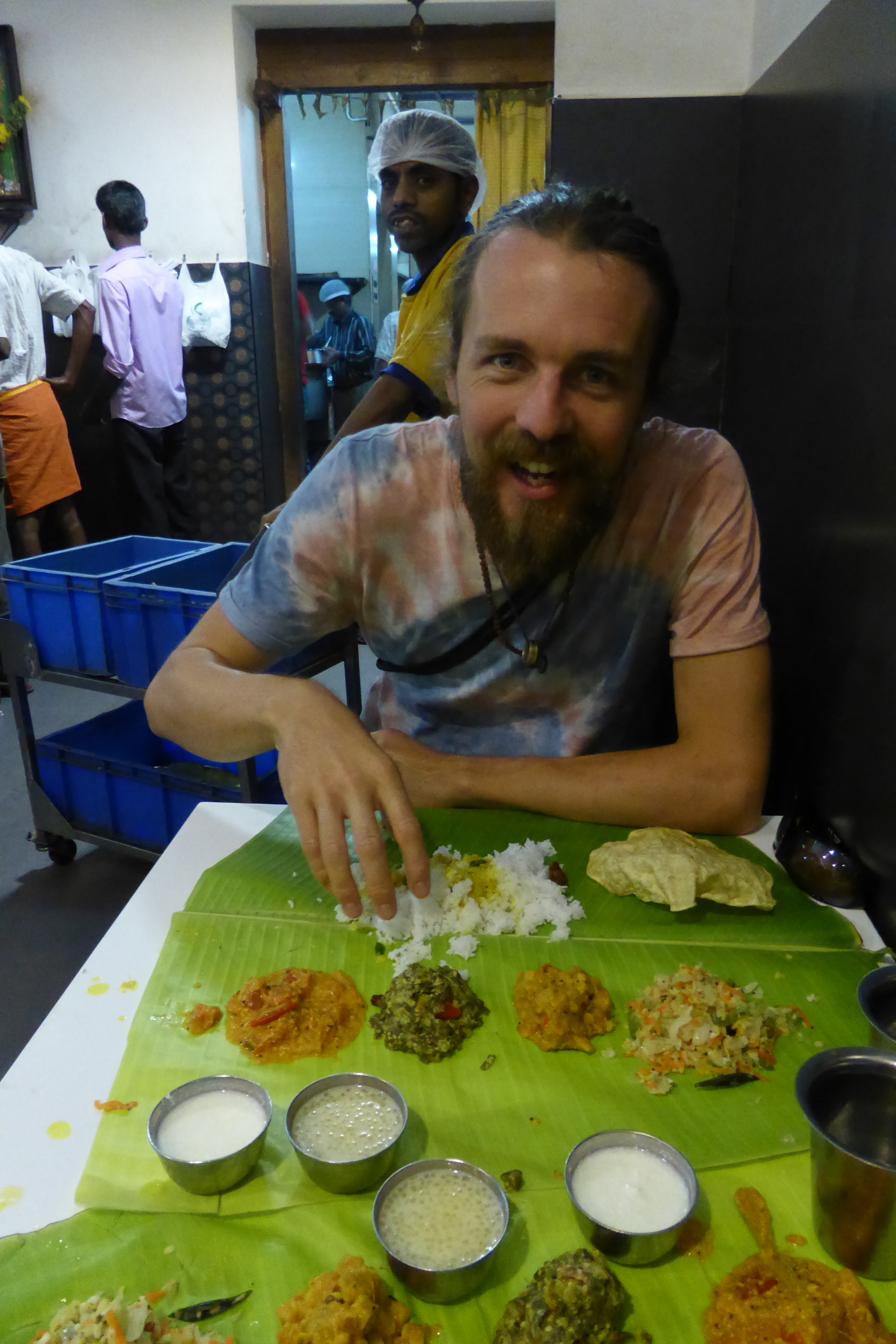
It's Thali time!!!! (South Indian style), Madurai, 3/14

It’s Thali time!!!! (South Indian style), Madurai, 3/14

Tawang Lake, way up in the Himalayas, Arunachal Pradesh, 4/14

Tawang Lake, way up in the Himalayas, Arunachal Pradesh, 4/14

Cooking up a monsoon, Rishikesh, 1/14

Cooking up a monsoon, Rishikesh, 1/14

Survival Travel Breakfast (Papaya and Chia Seeds)

Survival Travel Breakfast (Papaya and Chia Seeds)

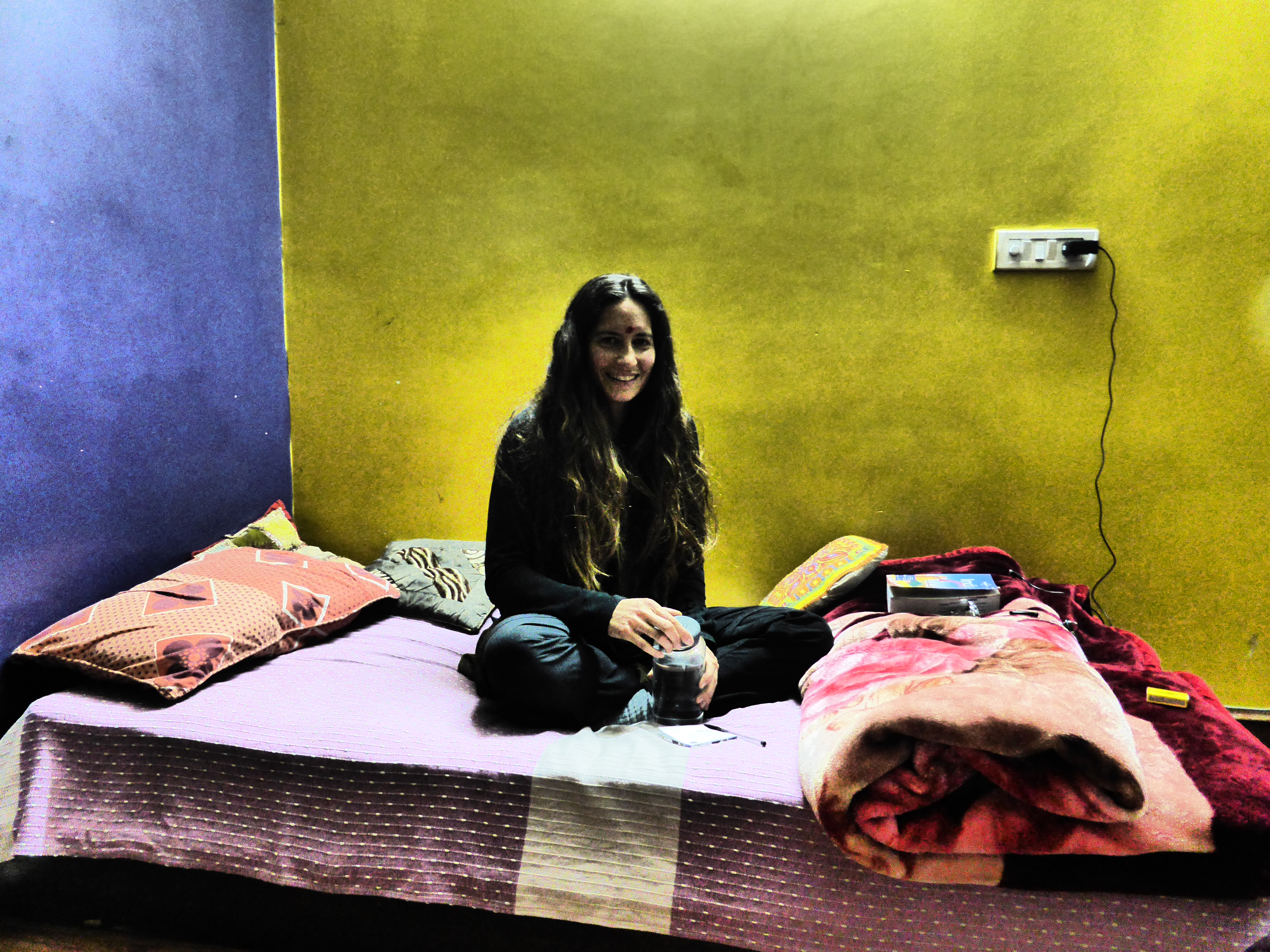
Jane, first day, first Bindi, Delhi. 1/14

Jane, first day, first Bindi, Delhi. 1/14

Vadas - some of South India's finest

Vadas – some of South India’s finest

A little taster, a canape of sorts, a wee bite into our last 6 months wandering the world.  We have a massive book full of new recipes to cook and hopefully post.  Its looking like a busy summer!

Love and Peace to all of you out there…..XXXXX

It’s great to be back, Lee and Janexxxxx

Categories: photography, Travel | Tags: , , , , , , , , | 3 Comments

Kala Chana Masala with Beetroot and Bok Choi

Jane on 'The Rock' - Karuna Farm, Western Ghats, Tamil Nadu

Jane on ‘The Rock’ – Karuna Farm, Western Ghats, Tamil Nadu

Finally, we post something!!!!  We have loads of half finished bits typed hurriedly in internet cafes, but have yet had the time and drive to actually finish one off!  

We’ve been in Indian now for three months and things have been thick with experience and too many foodie experiences to recollect.  Expect many Indian themed post soon, packed full of delicious and authentic recipes……. 

Kodai Kanal, Tamil Nadu 21st March 2014

Kodai is a little ex-British Hill Station (somewhere where the Raj used to go and cool off during the summer months).  Lots of little Anglo Indian stone cottages with lawns and chimneys, tea rooms and a beautiful lake.  We are staying on a farm, on a steep slope, with spectacular views over the plains towards Madurai.  It thick jungle, full nature and absolutely beautiful and best of all, we have a small kitchen to play in!!!!!

A random little post here, but we are half way up a hill in the middle of nowhere (Southern India). This recipe came together on our first night in Karuna Farm, in the green and verdant Western Ghats of Tamil Nadu. We have been sweating and meditating, sweating and yoga-ing, sweating and chanting our way through the early part of March in the Sivananda Ashram, outside Madurai. The temperatures soared, so it is magical to be up here in the mountains where the night air is crisp and the sunrises come on like an intergalactic firework show.

This is a spectacular little farm and we are witnessing many positive projects in motion. They are building earth ships, from recyclable car tyres and starting a permaculture project to supply the on-farm restaurant with some proper local produce.

On Sunday, Jane and I ventured up to Kodai Kanala (the main town). We walked through little villages, with many smiles greeting us, for 2 hours and then managed to catch a little rickety van the rest of the way to town (we’re quite remote here!).

Kodai is an old British hill station, with many rock built chalets and a large dollop of Christianity. It is now a popular retreat for Indian honeymooners and surprisingly few gringos on the streets.

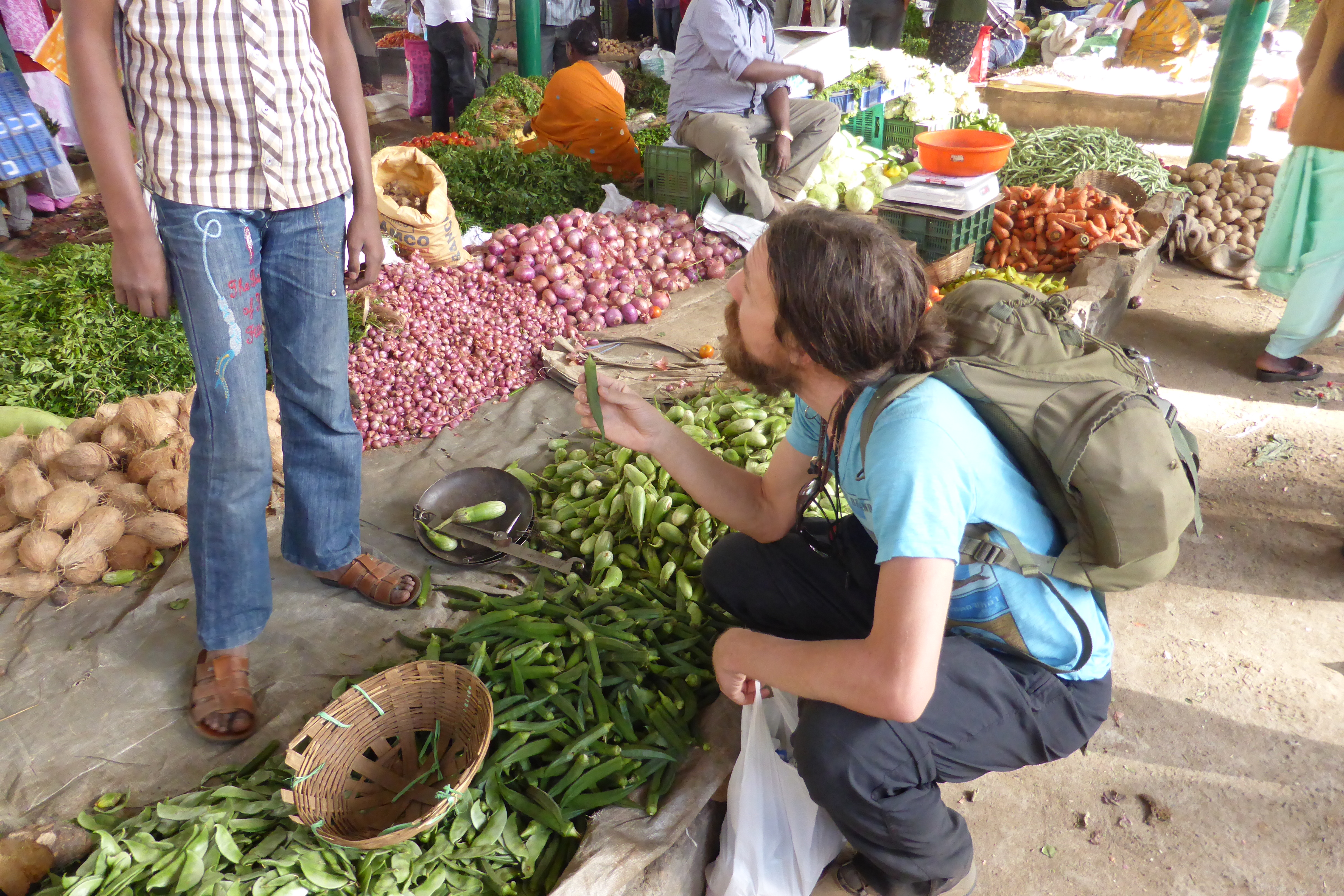
Haggling at Kodai Market

Haggling at Kodai Market

Sunday is market day and we spent most of it wandering around and ogling the local produce. Non of it organic, but all of it vibrant and full of potential. Our accommodation, a nice little cottage in a banana plantation, actually has a kitchen!  The first time we’ve been able to cook, apart from random cooking classes and making spicy tea with the chai wallas.  I was so chuffed to be having a bash at the pots and pans again.  We filled our backpacks with veggies and fruits and have not looked back since.

Internet in India is tough and I must apologise for the lack of BHK activity in recent times. We have heads full of recipes and new ways of conjuring up tasty nibbles.  We can’t wait to share them with you all from HQ (North Wales, which seems like a million and one miles away).

WHAT IS KALA CHANA?

Kala Chana (also Desi Chana or Bengal Gram) are brown chickpeas, unprocessed and packed with fibre.   ‘Kala’ actually means black in Hindi and Urdu.  They have more of a robust texture than your average chicker.  This type of chana has been enjoyed all over the world for millenia, from ancient Rome, Persia and Greece, to Africa and Latin America.  It has been used in British cooking since the middle ages.

Chana is so versatile to a veggie cook, we can boil them, sprout them, roast them in the oven, make them into magic puree’s (like hummus) or even make desserts with them.

We love this rough chana, especially in a dish with full flavoured veggies like cabbage and beetroot. A lovely old lady was selling these bok chois, we couldn’t resist them. I have never seen them cooked in India, but you wouldn’t expect us to be traditional now would you??!!

This is a highly spiced dish, similar to chana masala in many ways. The spices are warming including cinnamon and cloves, making it very much north Indian fare. In the South we have been eating mainly coconuts and white rice, the staple down here. Generally lightly spiced bu heavy on the dried chilli.

This dish, served with a massive salad, made a wonderful change and we actually cooked it ourselves! I have to say our bellies have not felt this good in the 2 month India adventure.

Jane washing up sporting socks and sandals, our new look

Jane washing up sporting socks and sandals, our new look

Grating the veggies for the sauce (called a masala over here) gives the overall dish a smoother texture and helps to thicken things up. Of course, grating things unlocks the flavours of the veggies and means you don’t need to cook them for so long to get maximum flavour.

I will be volunteering on an organic farm and cooking in a vegan kitchen soon, settling down a little. I imagine they will have internet and should catch up a little with the backlog of recipes and posts that have accumulated on my little computer gadget. There are some crackers!
Namaste and Much Love,

Lee and JaneXXXXXXX

The Bits – For 2
2 tbs coconut oil (or cooking oil)
1 large beetroot (scrubbed and diced)
6 large leaves bok choi (plus their fleshly stumps, chopped)
1 large carrot (scrubbed and grated)
1 small potato (scrubbed and diced)
1 big handful cabbage (grated)

Masala
1 onion (peeled and grated)
4-5 cloves garlic (peeled and grated)
1 ½ inch ginger (peeled and grated)
3 tomatoes (grated, skins discarded)
2 teas garam masala (or spice mix of your choice)
6 cloves
1 cinnamon stick
1 tea cumin seeds
1 teas black mustard seeds
2 tbs curry leaves
½ teas chilli powder
½ teas sea salt
½ teas black pepper

¾ cup chana daal (soaked overnight)

Brown Chana Masala with  Beetroot and Bok Choi

Brown Chana Masala with Beetroot and Bok Choi

Do It
Drain your chickpeas and rinse. Place in a small saucepan and cover with 3 inches of water, bring to a boil and simmer with a lid on for 1 hour (or until nicely tender).

Whilst they’re cooking, get your masala ready. In a frying pan, warm 1 tbs of oil, add the cumin seeds, cloves and cinnamon stick fry for a 30 seconds then add the onions. Fry all on a med high heat for 5 minutes, until golden.

Add the garlic, ginger and beetroot, fry for 3 minutes, then add the carrots and cabbage. Stir well and warm through. Cook for 5 minutes and add the garam masala, chilli powder and tomato. Bring to a boil and cover. After 10 minutes cooking on a steady simmer, add 100ml water and stir, then recover. Cooking for another 10 minutes. The sauce should be nice and thick.

Now add the masala to the chickpea pan, there should be some liquid left in the pan. Stir in and thin out the sauce with more water if needed. Check seasoning, adding salt and pepper. Be heavy on the pepper, chana masala loves pepper!

In a small frying pan, warm 1 tbs oil and add the mustard seeds and curry leaves on medium heat. Let the splutter for 30 seconds and remove pan from the heat.

Once the chickpeas are warm through, stir in the seasoned oil and serve.

No lights in our cabin, but candles are better anyway.

No lights in our cabin, but candles are better anyway.

Serve
In these parts we’d be having rice and rice (with a side helping of rice!)  but tonight, in our own little cottage, we’re having one of Jane’s bonza raw salads; with grated beetroot, kohlrabi, peanuts, beetroot leaves, carrot, coriander and lots more market fresh bits (when Jane does a salad, the entire veg basket is used!)

Sunrise outside the kitchen window

Sunrise outside the kitchen window

Foodie Fact
Kala Chana is very high in dietary fibre, one big bowlful of this curry with give women almost half of their daily intake of fibre (men a little less than that).  These brown garbanzos are also high in protein and rich in minerals like iron, copper and manganese.

Kala Chana is one of the earliest cultivated legumes, remains have been discovered dating back 7500 years!  India is by far the biggest producer of chana in the world, Australia is the second, which I find surprising.


Categories: Curries, Dinner, Recipes, Travel, Vegan | Tags: , , , , , , , , | 6 Comments

Chard, Coriander and Avocado Smoothie

P1000667

Quite a mad sounding smoothie, but we can’t get enough of it at the moment. It’s more of a breakfast pudding than a smoothie. You can drink it, but a spoon is probably the safer bet.

What we haven’t mentioned yet is that this smoothie is sweetened with banana, so its not all funky vegetal flavour, but actually well balanced and thick like beautiful green custard.

We experiment with all sorts of things in the blender and they normally work.  Kale is fine, some cabbages are hard to take (especially when sweetness is involved in the mix), asparagus is fine and spinach is a real hero, melding into all sorts of flavour combos.  Soaked nuts add dramatic richness, different milks are fun to play with and really anything that needs using up from the veg basket/ drawer can be smoothed out into something lovely and superbly nutritious.  It’s floppy leaf territory.

Recently we juiced a parsnip with excellent results.  Next up swede (rudabaga), which could prove quite a challenge.  Turnip juice sounds fresh and sweet……

I think  my body likes me even more when I give it a smoothie first thing, I can feel it smiling and appreciating the pureed magnificence.

Jane on a beach walk, near Bolunuevo, Mazzaron, Spain

Jane on a beach walk, near Bolunuevo, Mazzaron, Spain

The Bits – For 2

1 avocado (de-stoned), 1 bananas, glug of rice/ soya milk, 3 chard leaves (stems kept for a stir fry), handful coriander leaves (stems in or out)

Do It

Place all in a blender and blitz into a very thick smoothie.

Hands off!!!!!!!

Hands off!!!!!!!

Serve

We love it with a splash of milk on top, like a green pint of guiness, you can then mix the ‘head’ in with a spoon.  It also looks very cool (the importance of which is never underestimated in the BHK).

We Love It!

Thick and green, two things we always appreciate, add sweet to the mix and sold.

Foodie Fact

Coriander (or cilantro) hails from the Mediterranean and like all green things boasts an almost ridiculous amount of antioxidants.  It helps fight ‘bad cholesterols’ and has a brilliant range of vitamins.  Coriander  has one of natures highest levels of Vitamin K which helps us in so many ways, mainly assisting the bones in growth and repair.

Categories: Breakfast, Healthy Eating, Recipes, Smoothies | Tags: , , , , , , , , ,

Simple Chickpea & Pumpkin Stew

Simple Chickpea Stew

Simple Chickpea Stew with load of lovely coriander

In the Beach House we love simple cooking with a smile and this stew definitely makes us beam a bit.  We’ve just landed in Spain after a crazy few weeks in the UK for a variety of reasons that we’d prefer not to bore you with.  I am super busy on a food based project that I will no doubt tell you about soon, but until then, the posts are going to be few and far between as I type my little fingers to the bone.

Some of you may have read about our winter retreat last year, near the sleepy port town of Mazzaron, up near the hills (you will no doubt be unsurprised to hear).  It’s a real country area and the Med sparkles from our terrace every morning and each night sky is filled with incredible maps of stars.  All that sun means there are some amazing veggies for sale here in the markets and we have loved having a dabble and a haggle!  We pick up ridiculous bargains and then get home and wonder what on earth we are going to do with it all…!  We only have a little kitchen and the Beach House Kitchen (Part II) is slightly underequipped compared to the gleaming ‘Thunderbird 1’.

Our favourite new bit of equipment is a wooden handled knife that we picked up off a flamenco-loving-gypsy-with-a-mullet for a euro.  It seems to be impervious to bluntness.  The Excalibur of onion chopping and potato peeling.  It is worth mentioning that we buy lettuce and tomatoes from this fellow’s Mum, who normally wears a pink dressing gown and a has a cigarette hanging from her mouth.  The dressing gown is held together by a piece of frayed string and is probably one of the most fashionable statements on display, come market day, in little Puerto Mazarron.  We love that market, but this week it was called off due to adverse weather conditions.  It rained a little and was a little blowy!  We wouldn’t get much done in Wales with these kind of restrictions.

We have just spent a busy week with my Mum doing plenty of café and bar hopping and taking in a few ancient looking little towns along the way.  Unfortunately every time we’ve got the camera out, at least one of us has been stuffing our face with tapas, so we are short of pleasant pictures of us lounging around the place.  I’m sure you can imagine the scene we enough and I hope we are not rubbing in our good fortune to be here.  To balance things out, I have had my normal restaurant experience in Spain, which go a little something like this:

Step 1)  I apologise profusely for being a non-ham eater, smile through the imminent baffled glare and disdain, then fully expect the worst…..

Step 2)  I am faced with a decision to eat around fish and or meat or go hungry.

Step 3) The next course arrives and I revert to Step 2

Step 4) I end up just eating fruit for dessert

P1000526

Vibrant veggies in the mix

Having said that, the wine is good and cheap and this carries me through each disappointing dining experience.  You’ve got to love the people in our local restaurants though – a brilliant bunch of rogues, fishermen and real characters.  Veganism has not reached these parts, but when it does, it will be repelled with sharp sticks and incredulous words.  NO HAM!  What are you, insane!!!!!  I love them all, even if they think I am from the planet Parsnip.

NB Casa Monika’s in Puerto Mazzaron is not included in this generalization, as one of the LOVELY owners Jose is Vegetarian/ Vegan, and the food rocks. Thank YOU.

So……we keep things even simpler in Spain and this was a stew we had for dinner last night and thought you guys would love.  The chickpeas here are little works of art, after soaking they swell up like small plums and the spices are very, very potent.  The smoked paprika almost takes your breath away and the cumin we can still smell even when its sealed in a jar in a cupboard (at first Jane thought I had some strange musty body odour thing going on).

We use a lot of vegetables here, making full use of our mammoth stash, but you can really pick and choose what ever is handy.  The classic combination of warming spices and chickpeas will lend itself to almost any vegetable.  As you can see, I like to sweeten it a little with dates, it seems in-keeping with the style of the dish.  You can always omit the sweetener, or use some honey or brown sugar.  Another idea we have been playing with recently to good effect is adding a little soya milk to stews and soups; it is surprisingly creamy and changes the texture.  You may like to throw a cup of soya milk in here and see how it goes (it will go well!!!!) Jane did it by mistake the other day confusing the carton of stock with Soya milk in a pea and mint soup… it was a lucky accident (the less said about her vegetable stock-on-muesli accident the better though)!

The coriander and glug of olive oil at the end sets this dish apart, as with so many stews and soups, that little finishing touch makes all of the difference.  Golden olive oil warmed on a stew is something almost to gorgeous to describe in feeble words.  I am sure Jane would say ‘It’s ace!’ and I would certainly agree.

I’d love to think that we’ll be posting again soon and we’ll be drinking G and T’s on the terrace on your behalf!  It’s a Beach House life, what can we say!!!!!

Lovely salad accompaniment

Lovely salad accompaniment

The Bits – For 4-6

1 inch and a half square ginger (grated), 3 garlic cloves (peeled and grated), ½ tsp cinnamon,1 tsp ground oriander, 1/2 tsp smoked paprika, 1tsp ground cumin

2 tomatoes, 1 tbsp tomato puree (depending on how good your tomatoes are), 1 carrot (finely diced), handful of cabbage leaves (or other greens), 1 onion (finely sliced), 1 cup of pumpkin (medium sized cubes), 1 small courgette (same size as pumpkin), 2 handfuls of spinach leaves.

3 cups of chickpeas (with cooking juices), 4 fresh dates (finely chopped), 1 cup vegetable stock, sea salt and pepper (to taste)

Fresh coriander leaves and stalks (for topping)

Do It

Soak the chickpeas overnight and cook them in fresh water for roughly 45mins- 1 hour  (add 1 teas of bicarb of soda to speed up the cooking process).

In a hot pan, brown the onions for 3-4 minutes. Then add the fresh ginger, garlic, pumpkin, carrot and courgette. Fry them off for 5 minutes.

Now add the cabbage leaves, cumin, sweet paprika, ground coriander, cinnamon, and chopped fresh tomatoes (with the tomato puree if you’re using it). Time for the chickpeas with their juice from their cooking and a good old stir.

Add one cup stock if needed (if you haven’t got enough chickpea juice). Bring to the boil and cover and simmer for 10-15 minutes or until the carrots are nice and tender.

Sprinkle in spinach leaves cover and turn off heat.  Leave for 5 minutes and give a final stir and serve.

Even more salad reinforcements (we eat alot of salad in Spain!)

Even more salad reinforcements (we eat alot of salad in Spain!)

We Love It

This is our every day type stew, full of veggies, flavours and goodness.  This is the type of winter fuel that sparks us into life! We worship the tasty spicy-ness of this dish.

Foodie Fact

Chickpeas are super high in fibre and are renowned for their ‘filling’ properties.  Eat a few, feel full, don’t snack on all those beetroot crisps you’ve got locked away in the cupboards.  Chickpeas have been shown to help stabilise insulin and blood sugar, they are also awesome for your digestion and colon.  Lovely little chickers!!!!!

Categories: Dinner, Recipes, Vegan | Tags: , , , , , , , , , | 2 Comments

Goodbye Buster (The Worlds Coolest Cat) and Big Hello from Spain!

OLYMPUS DIGITAL CAMERA

Buster (aka, Buzzy, Buzz-man, Buzzeroonie, Buzz face, Raja, Buzzer, Buzzoid, Buzzeroo, Busty, Little Tiger………and other pet names) has left the building. He is the most wonderful little guy, but we are now in Puerto Mazzaron, Spain and soon to be in India for an extended period and we couldn’t find a way of keeping him close.

OLYMPUS DIGITAL CAMERA

We managed to find a brilliant home for the Buzzman in the next valley, real animal lovers.  The first night he went to his new home, he made his way back over the mountains at night and turned up at the back door, a little peckish.  He must have used the stars as a map to make his way across the streams and hills, its around 5 miles away.  What a little grey star he is!

Just looking at our recent lack of posts makes us very ashamed of our behaviour. We miss the posts but have been busy with other exciting projects, more about these very soon…….  We have been cooking shiny food all the time and have a huge backlog of photographs and recipes to post, we just need a little time and internet access (which always helps!)

Much Love from us and have a magical festive timeXXXXXX


Categories: 'The Good Life' | Tags: , , , , ,

A 10 Minute Meal – Hazelnut Tofu and Soba Noodle Broth with Red Pepper and Brussels Sprout

Hazelnut Tofu and Soba Noodle Broth - On the hob

Hazelnut Tofu and Soba Noodle Broth – Bubblin’ away

Here we have a delicious 10 minute meal.  5 minutes chopping, 5 minutes cooking and it won’t last long in the bowl either.  So simple, yet tastes so amazing and dare I say it, complex.  You have to love that!

Nothing says British winter more than a bowl of Soba Noodle Broth….or is that just me!  I love a noodle broth anytime of the year and this one is wonder, putting the years first brussels sprout to good use.  I could eat this by the bucket full, bowls just aren’t big enough.

The first winter chills are definitely visiting the Snowdonia hills at the moment, the winds blows a gale and we’ve kissed goodbye to what was a lovely summer of warmth and light nights.  Sitting in the garden at 10pm in the sun is surely a thing all Britons cherish.

The Beautiful Nantlle Valley - just behind the Beach House Kitchen

A view from the beautiful Nantlle Valley – just behind the Beach House Kitchen, where we walk when not eating like Tokyo-ites

As are brussels sprouts.  They’re like little cabbage hand grenades and add a punch to all they grace, we love ’em! So, so, so very wasted on your average Sunday Roast (traditional British Sunday Lunch containing roast meats and unfortunately over cooked vegetables), boiled to death and flaccid. A quick blanch in this broth and they are a revelation of crunchy texture and potent flavour.

This is an ‘Asian’ broth, which I know covers a large chunk of global cuisine.  Its a hybrid of flavours that meld and work.  Some Japanese, some Chinese, but all super tasty.

In the Beach House we condone slurping in all its forms.  Food should be eaten with gusto and vigour, slurping is an essential part of the noodle broth experience.  We like to attack a bowl of noodle broth armed with a large spoon and some chopsticks, on occasion we resemble koi carp, such is our commitment to the cause.  Jane is a particularly good slurper, we put it down to being raised with a koi carp named bonehead.  Bonehead still lives with Jane’s Mum and Dad and is a big fish in a small pond.  He can also be stroked like a dog.

Jane, is that you?!  Koi carp – like jaws in a pond

This type of broth is best served piping hot, with all ingredients cooked for the minimum length of time.  Freshness and crunch is imperative.  The gulping and slurping actually helps the noodles cool down on the way to the mouth.  At least that’s our excuse!  It also happens to be alot of fun.

We’ve added plenty of colour here, essential in these gradually greying months, by using the last of the years red peppers and some brazen red cabbage. This broth is also nice and warming, fresh ginger and Chinese five spice take care of this.  For even more of a restorative slurp, I added some wasabi to mine which really got my juices flowing.

SOBA NOODLES

Soba noodles are always a highlight, soba meaning ‘buckwheat’ in Japanese, the noodle choice of most Tokyo-ites.  Traditionally in Japan buckwheat can be harvested four times a year, a wonder crop for sure.

Soba Noodles have a lovely bite to them, a hearty noodle ideal for my rapidly diminishing wheat intake as they are made with a large amount of buckwheat (not a wheat even though it is called a wheat!?) This means less gluten all around. For some bizarre reason, soba noodles are normally a tad more expensive than your average joe noodle, but they’re well worth the extra pennies.

Soba Noodles

We use tamari because we prefer the flavour, it contains no wheat and is always made to a certain standard. Meaning no strangeness and dodgy health issues with the soya used.

There are alot of ingredients in the broth here, really, some good stock, ginger and a splash of tamari will suffice, the other ingredients just make it extra special. Most of them can be found in any decent Chinese-style food store.

As can the Hazelnut Tofu.  It’s basically tofu mixed with hazelnuts, and a few toasted sesame seeds, pressed back together.  It is delicious and has plenty of flavour, unlike normal tofu.  It seems to be springing up in some supermarkets, but as with most of these niche veggie/ vegan bits, a health food shop is your best bet.

Makes two massive bowlfuls (or four medium sized):

The Bits
300g soba noodles, 125g hazelnut tofu (chopped into little cubes), 1/4 red cabbage (finely shredded), 1 red pepper (finely chopped), 6 brussel sprouts (finely sliced lengthways)

For the broth – 1 inch fresh ginger (minced), 2 teas chinkiang vinegar (balsamic will do), 2 tbs tamari (soya sauce is a close sub), 1 tbs rice wine (or dry sherry), 1 tbs good stock powder (or fresh if you are brilliant) – to taste, 1/2 teas Chinese five spice, 1.5 ltr boiling water

Taste the stock, make it right for you.

Wasabi stirred in to taste (if you like things spicy)

Topping – 2 spring onions (finely sliced)

Do It

Boil a kettle with enough water.

Chop your vegetables thinly.

Add boiled water to a large, warm sauce pan and get a steady boil going.  Bubblin’.

Add all of your stock ingredients in no particular order, give it a stir (no stock powder lumps, they are the enemy).

Now add your cabbage, brussels sprout and peppers, boil for two minutes, then add your tofu and noodles, simmer for a further two-three minutes and prepare to serve.

By the time you’ve got bowls and ladles and all that jazz together, your noodles should be cooked nicely.  Overcooking soba noodles is a huge sin.

Serve
Piping hot and topped with a handful of sliced spring onions.  If you have a small flask of warm sake available, well done!  Have extra tamari, wasabi and vinegar on the table so people can play with the flavouring or their stock.

Hazelnut Tofu and Soba Noodle Broth with Red Pepper and Brussel Sprouts

Hazelnut Tofu and Soba Noodle Broth with Red Pepper and Brussel Sprouts – Camera in one hand, large spoon in another…….

We Love It!

Soul slurping of the highest order and buckwheat noodles to boot.  Lucky us.  So quick and satisfying, we could eat this for dinner every night!  A soulful soup of the highest order.

Foodie Fact

Buckwheat is high in Thiamine and soba noodles were regularly eaten by wealthy  Japanese folk to balance their large intake of white rice (very low thaimine) thus avoiding what was called ‘beri beri’.

As we all know by now, buckwheat is a relative of rhubarb!  A berry and not a grain, a wonderful gluten-free substitute.  Buckwheat is full of flavanoids which are very good for the cardiovascular system.  In fact, some folk say  that buckwheat is better for you than any fruit or vegetable.  Quite a claim!

Categories: Recipes, Soups, Vegan | Tags: , , , , , , , , | 12 Comments

Morcilla De Verano – Spanish-Style Aubergines

P1220010

Morcilla De Verano

A traditional vegan classic from the south of Spain, originally cooked to replicate Morcilla (black pudding basically).  You regularly see it served around Murcia, especially on tapas bar counters.  Its a great option for me in the land of jamon.  All Murcians know the dish and are rightly proud of it.  We’ve added some tempeh to the traditional recipe making it more of main event.  I love cooking aubergines right down with sweet onions and the addition of proper Spanish herbs and spices really pack a punch flavour wise.

Even though its called a ‘summer’ dish, we think this is great all year around.  Due to its slightly meat like texture, this is a dish to sate all.  We’re always trying to find dishes that will appeal to meat eaters aka most of our family and friends.  This is exactly what this dish was created for, people couldn’t afford meat and were looking for a delicious substitute.

You know, I love Spanish food and this dish really taps into the rustic heart of their magical range of cuisine.  Spanish food speaks of the land and culture.  It is the perfect expression of such a diverse land and for me, the cuisine of the South perfectly matches the arid plains and craggy red mountains.  Its rugged, its got bags of soul and it can take your breath away.

As some of you will know, my parents have a little place over in Murcia, Jane and I are regular visitors chasing the sun and the peaceful Med life.  This dish is based on a recipe passed to us from wonderful friends over that way, Fey and Jose.  It is actually Jose’s brother Andres recipe and he created it in an attempt to eat less meat (he’s a real maverick in the area, only 0.3% of Spain’s population are veggies after all).  I still have the little scrap of paper that he wrote it down on one night, for me that is real soul cooking.  This recipe is connected with so many memories of wonderful people and places, we can’t help but love it.  We have of course made our usual Beach House alterations, but this does not stray too far from Andres Murcian delight.  Gracias HombresX

Recipe Notes

Don’t be shy with the oil here, remember it is Spanish after all!  The dish should be slightly on the oily side which of course makes it very rich and satisfying.  After eating this for dinner Jane exclaimed “I feel like I’ve just eaten meat and two veg” rubbing her belly.  Always a good sign.

We decided that this is a star dish and very versatile.  It could be used to stuff a vegetable, a courgette or potato sounds perfect.  Of course, its great for tapas and picnics and is lovely even when served cold.

Buen Provecho!

The Bits

2 small aubergines

1 courgette

1 small onion (all three finely diced and kept seperate)

2 garlic cloves (crushed)

2 teas fresh rosemary (finely chopped)

2 teas sherry vinegar

2 teas sweet paprika

1/2 teas cinnamon

1/2 teas all spice

2 teas fresh oregano (finely chopped) or 1 teas dried

200g tempeh (or tofu)

1-2 teas sea salt

1 1/2 teas cracked black pepper

Olive oil (for frying)


Topping

2 tbs toasted pine nuts or almonds


Do It

This is a three part saute/ pan frying routine, meaning a number of stages until your meaty morcilla is just right.  The trick is to get everything nicely caramelised, bringing out maximum flavours.

P1210989

First saute, courgettes and aubergine

Start with your aubergine and courgette.  Add 2 tbs of the oil and warm on a medium heat in a heavy based frying pan.  Add the aubergine and saute for 8-10 minutes, until nice and golden and releasing some of their liquid, then add the courgettes and continue to saute for another 5 minutes.  This is the real flavourful aspect of the dish, the aubergines should be nicely browned and gorgeously sweet by this stage.  Set aside.

Next, your tempeh needs sorting.  Chop it up finely, it will resemble dried scramble egg.  Add 1/2 tbs of oil and saute for 5-7 minutes, until it is beginning to get brown around the edges.  Set aside with the aubergine mix.

Now, add 1 tbs oil, fry the onions in the same pan (wipe out if necessary).  Lower the heat if things are getting a little hot.  Stir, the onions should take 6-8 minutes to become golden, we don’t want to rush them and risk burning them.  Once they are golden, add the garlic and cook for 3 minutes, pop your vinegar in to a big hiss.  Now it’s time to spice things up.

Add your paprika, all spice and cinnamon, saute for a minute, stirring all the time and not allowing the mix to stick.  Then add your herbs and the aubergine/tempeh mix to the pan.  Stir well and warm through for a couple of minutes.  Your ready for the plate.

P1210999

Warm through and enjoy the awesome aromas

Serve

In a warm serving dish, topped with some pine nuts and a sprinkling of paprika.

We served our morcilla with some steamed green vegetables (broad beans, runner beans and broccoli) with some pan fried lemon cabbage.

P1220008

Morcilla de Verano – looking good!

We Love It!

Really satisfying rustic style Spanish fare.  I imagine this is pretty close to Morcilla itself and cannot wait to try it out on some meat eaters.  Dads coming soon, one of our favourite guinea pigs.

Foodie Fact

Pine nuts are just incredible little things.  Now so expensive, but worth every penny as a treat item.  They can make a real difference to a dish, especially when roasted a little to bring out the flavour.

Pine nuts are full of vitamin A, so you’ll be able to see in the dark.  They have good levels of vitamin D, for the bones and are also rich in vitamin C and iron.  They are quite fatty, which is obvious when you enjoy them, but its mono-unsaturated fats.  Pine nuts are also packed full of energy, great on cereal for a morning buzz and fizz.

P1220037

Served with some blanched summer greens – Not bad for Thursday!

Categories: Dinner, Recipes, Vegan | Tags: , , , , , , , , , , | 12 Comments

Raw Vegan Lasagne with Avocado and Lemon Ricotta (Gluten-free)

Raw Lasagne with Avocado and Lemon Ricotta (Vegan/ Gluten Free)

Raw Vegan Lasagne with Avocado Lemon Ricotta, Red Bean and Walnut with Tomato and Basil Sauce (Vegan/ Gluten Free)

This is one of those dishes that really stands out.  A dish that just makes perfect sense and falls into place perfectly on the plate and palate.  All those yummy layers, one on top of another.

Meat eaters beware!  This is a ‘converter’, one fork-full and you’ll join the lighter side.  A dish that dis spells the ludicrous myths that vegetarians are merely ‘rabbit food’ munchers.

We have found vegan raw food presents a simple equation:

Raw Vegan Food = Shiny and Zinging Life of the Highest Order + Awesome, Creative New Flavours and Combinations

Granted its not the simplest of equations, but its a fine one non-the-less!  This dish is full, full, full of delicious flavour, nutrition and vegetarian protein power (see top 5 veggie sources of protein here).

Jane was typing whilst I made this and here is what I said about it, hot off the press:

“So good for you and tasty, I can see this stuff really catching on!  I see this as the future of food.  Its a simple as that.  Pasta without the carbs, supercharged full of colour and nutrition, all the flavours of Italy.  Fascinating combination of flavours only ever seen in vegan cooking, using all whole foods, nothing jarred – this is what we are going for in the BHK.”

Reading this back again, I completely agree with what my former self uttered.  This is the future of cooking (and non-cooking).  We all want the best for ourselves and raw vegan food gives us just that.  This is a trend that is actually positive for mind and body.  Can you imagine how much the National Health Service would save if we all decided to eat vegan raw food, or incorporate more of it into our diets.  We’d all live to 150 and hardly ever darken the door of a hospital or doctor.  We believe that nutrition and the food we eat is that important.  Call it preventative medicine if you will, but taking care of yourself and eating amazing food doesn’t sound like too bad a deal.  No compromise on taste either, just look at this wonder plate!

Semi-rant over for now, back to the recipe.  Its not totally raw this one, but could be very easily.  Because Raw Earth Month has now officially ended (yes we are using the odd light at night and the occasional square of chocolate is disappearing from the cupboard) cooked beans have re-entered our diets.  How I missed them.  I love a bean.  Without even thinking, I added red kidney beans to the ‘meat’ layer of our lasagne.  They are perfect colour wise and they add a great texture.  I also love them with walnuts, no idea why?

We are lucky to have a raft of inspirational friends and the original idea for this lasagne comes from the sparkling Sava over at Travel Butterfly.  Sava is a constant source of inspiration on many levels for us at the Beach House and some of her vegan/ raw recipes really hit the wonder mark.

This lasagne, and lasagne in general, has a few components to sort, it takes a little time.  Its well worth it though and would definitely be classed as a special occasion dish.  This dish has the whiff of wow factor about it, one that looks almost as good as it tastes (after all, food that looks better than it tastes is such a let down).  I am always interested to find that most people who don’t cook much still know how to make a decent lasagne.  Its quite a tricky and time consuming thing to get together, especially the art of a non-lumpy bechamel.  I generally think people are alot better at cooking than they claim to be!

Raw Vegan Lasage

Raw Vegan Lasagne

Good tomatoes here are essential.  We had some in our veg box this week and they blew us away, when I tried the sauce, I couldn’t believe I hadn’t added a sweetener to it.  That’s it reaction you need!  Gorgeous tomatoes are hard to find.  Some tomatoes just need a little love, leave them in a bowl, ripen them just like a fruit and sometimes they come good, at the very least, they will get better.  A chilled tomato is just no good.  There is a soup we made a little like this, found here.

If you are completely raw, we’d probably substitute the beans with more seeds and nuts.  Maybe a little dried apricot to bind things together.   I am sure you have your own ideas, as being a raw vegan really pushes your creativity to the limits.  We know how it is.

We use amino acids of tamari here because most soya sauce is just no good.  Soya is a funny thing and unless processed properly, can be of detriment to the body.  Tamari and something like Braggs Liquid Amino Acids are perfect replacements and tamari especially, even tastes finer.

We top this all off with some Nutritional Yeast Flakes.  I know we all don’t have them in the cupboard, but they are brilliant little flakes to add an almost cheesiness to dishes.  They have a unique savoury taste that must be tried to appreciate and are a vegan lifesaver.  For me, they are little like a vegan parmesan.  That intense!

A few other raw recipes that may tickle your tastebuds:

Black Prince Tomato and Coriander Soup

Crunchy Thai Salad with Green Coco Dressing

Raw Coconut and Lime Cheesecake

Hazelnut and Lentil Hummus


Now, lets non-cook!


The Bits

Tomato and Basil Sauce
3 cups plum cherry toms, 1 cup soaked sundried toms (finely chopped) with ¼ cup of oil from the jar), 1 cup fresh basil leaves, 1 tablespoon balsamic vinegar, 1 teaspoon dried oregano, 1 clove crushed garlic (crushed)

Bean and Walnut Layer
250g red kidney beans (cooked) or 1 tin-ish, 1 cup of walnuts, ½ cup of pumpkin seeds (add bite), 2 x teaspoon Braggs Liquid Aminos (or tamari), Pinch of salt and pepper

Pasta Layers
1 gold courgette, 1 green courgette (or two green is fine)
Cut in half width-ways and finely sliced into layers

Avocado and Lemon Ricotta
1 ripe avocado (must be ripe), 250g firm tofu (drained well, save a few thin slices for the topping), 2 tbls olive oil, ¼ cup nutritional yeast flakes, 1 small clove garlic (crushed), ½ lemon juice and zest, pinch of salt

Topping
Thinly sliced tofu, olives (finely chopped), sprinkled with Nutritional Yeast Flakes

Do It

This raw game is an easy one.  Just whack it in the food processor and voila!  Gorgeous Lasagne.

Tomato and Basil Sauce – Pop all in a FP and whizz until smooth.  Set aside and clean blender.

Bean Walnut Layer – Pop all in a FP and blitz until smooth but with lots of chunks (similar to mince I guess).  Set aside and clean blender.

Avocado and Lemon Ricotta – Pop all in a FP, blend until smooth.  Set aside.

Pop all in the fridge for an hour to chill and thicken up a little before the layering.

Raw Lasgane ready for stacking

Raw Lasgane ready for stacking

Make sure that you slice you courgette/ zucchini carefully.  You want them to be almost as thin as pasta sheets.  A mandolin is perfect for this, but a big beware here!  They love to slice fingers also.

Now to layer the beast.

On your chosen serving plate (a square one would be perfect), lay out your first layer of courgette. Depending on your chopping skills, you may need to put two layers of courgette (if wafer thin style).  Carefully spread on your bean and walnut layer and a thin layer of the tomato and basil sauce.

Next, add another layer of courgette, slightly smaller in diameter than the first, pressing down gently to make the layer stick.  This is mainly a presentation thing, you can see the layers better when they are not overhanging each other.  Once the layer is neatly placed, spread on your vegan ricotta.

First layer underway

First layer underway

The final layer, once more press down gently and arrange a nicely overlapping mosaic of your wonderfully sliced courgette, top with a layer of tofu (which can’t help but look a little like mozzarella), a good layer of tomato and basil sauce, sprinkle on your chopped olives and a good sprinkle of yeast flakes.  Top with some basil that you will no doubt have hanging around your glorious kitchen.

That’s it!  As simple or as difficult as you make it!  We think its medium in the ‘fiddle scale’.

Raw Vegan Lasagne with Avocado and Lemon Ricotta - A taste explosion waiting to happen.

Raw Vegan Lasagne with Avocado and Lemon Ricotta – A taste explosion waiting to happen.

Serve

Immediately.  The salt will gradually release liquids in the lasagne, which are very tasty, but don’t look the best.  This lasagne can be sliced as usual and the layers will stay intact and look amazing.

We Love It!

A dish in the locker that will impress friends and family for many years and make us look very clever indeed when actually its leisurely walk in the park.

The flavours mingle and merge in some form of Italian perfection and you will be amazed at the reaction from meat-eaters.  Try it!  They love it too!

Foodie Fact

Courgette (zucchini to some) is a summer squash, they are said to have originated in Mexico and come in all shapes and sizes.   Courgettes are very low in calories and have no cholesterol or fat, the peel is full of dietary fibre and it is also a good source of vitamin A and has high levels of heart friendly potassium.

Jane's been making dollies out of wheat again.  This is Trevor.

Jane’s been making dollies out of wheat again. This is Wild Johnny.

Categories: Healthy Eating, Raw Food, Recipes, Special Occasion, Vegan | Tags: , , , , , , , , , | 7 Comments

World’s Best Kitchen Implement – Skrub’a Gloves!

Jane happily skrubbing!

Jane happily skrubbing!

A very lovely friend from Germany sent us the most fantastic present the other day, the like of which we have never seen before on Welsh shores! Introducing Skrub’a The Scrubbingglove  – a clever Danish invention in a pretty orange carrot design!

These wonder-gloves could not have come at more perfect timing (another wonderful synchronicity, thanks Nicole). You probably know that we are now lucky enough to be loving the weekly fresh local and organic veggie box grown by lovely Pippa and John down the road…. Such delicious, fresh and DIRTY veggies! Up until now the lowly washing up brush has been doing all the hard scrubbing work. But we find that still leaves little bits of dirt on the veggies, especially in the nobbles and bumps.

gloves

gloves

It was with delight and happy intrepidation that we donned the gloves for the first time, dunked the root veg and began skrub-ing them with our gloved hands. The gloves (very much like those exfoliating shower-mitts) were utterly perfect at getting into the grooves and pits of the most twisty of carrot.

It was a quick and unusually satisfying job, and at the end of it we had smiley faces and very clean beetroots. Not only that, but 50% of the vitamins in veggies are in the peel! So Skrub’a Gloves thank you very much, you are our new favourite kitchen implement!

Categories: 'The Good Life' | Tags: , , , , , , , , | 9 Comments

Apple Mint Herbal Vinegar – Health Tonic Extraordinaire!

delicious minty vinegar

delicious minty vinegar

It has been a luscious blossoming blooming year for gardeners across the land. Much sunlight and only occasional rain has kept most of the slug and snail critters at bay, hoorah! And over in Staffordshire, Mum and dad’s apple mint went wild again, and started springing up everywhere in places most unexpected. We were lucky enough to be at the right place at the right time to harvest the lot, bring it back to the Beach House Kitchen and get creative.

When faced with huge armfuls of thick 3ft long mint stems, it is easy to find yourself wondering what on earth you’re going to do with the bounty of furry goodness there in front of you! But luckily there are many ways to preserve herbs – in oils, vinegars, dried in jars; and many uses for the finished product like salad dressings, flavouring for your cooking, teas and delightful herbal baths! Lets face it a whole shelf of different herbal vinegars is pure visual delight – and that’s before you’ve even eaten any!

yummy mint, fresh and dried

yummy mint, fresh and dried

The Bits

Glass or plastic jar with waxed paper and elastic band for lid if metal (vinegar disintegrates metal lids)

Apple cider vinegar with the mother culture (great for your digestive system)

Aromatic herbs, such as apple mint (or all the other kinds of mint too), chives and chive blossom, dandelion flowers and leaves, organic orange peel, lavender flowers, even nettles…. The list goes on…

Do it

Fill a jar with your freshly cut chopped herbs, making sure the jar is well filled but not packed too tightly either… (After a few goes you’ll get the idea, I don’t think I put enough in ours)!

Pour room-temperature apple cider vinegar into the jar until it is full.

Cover jar with wax paper held on with a rubber band and metal lid on top, or a plastic lid, or a cork.

Label the jar with the name of the herb and the date.

Put the jar in a kitchen cupboard not too hot and not too cold but out of direct sunlight and leave for 6 weeks.

Don’t forget it’s there!

Serve

Over salads or beans and grains at dinner, in salad dressings, or to season stir fries and soups.

You can even drink it in the morning in a glass of water as a health tonic, after all what could be more healthy than your own produce soaked in apple cider vinegar!

We love it

There’s a lovely aspect of this creative process too and it’s all about the love and appreciation of food that has come out of your own soil. The very act of stripping the leaves from the stem, drying them, and getting creative all feels like a very natural and heart-warming process; one which our ancestors would have done too, to preserve that nourishing goodness of Summer ready for darker Wintery times. And it is SO good for you! Daily use of preserved herbs gives you a little health boost with virtually no expense or effort.

Foodie fact

Herbs are magic because of the high level of nutrients they contain – mint for example contains a lot of Calcium.

Apple cider vinegar has been known as a health-giving agent for centuries. Hippocrates swore by it, along with honey. It is incredible at lowering cholesterol, improving skin tone, and even for arthritis. It is also very good at dissolving nutrients from plants which water is not so good at, meaning this vinegar is super-healthy and mineral rich.

Ever seen your granny splash some vinegar onto her greens before serving? Eaten with iron rich vegetables like spinach or broccoli, vinegar can increase the amount of calcium you get by a third. Pretty amazing stuff!

Vinegar is highly alkaline, I know that sounds strange, but when it is metabolised by the body, it goes through a serious change.  Alkaline foods are incredible for health and keep disease and other baddies at bay.

minty spiral

minty spiral

Categories: Foraging, Infusions, Recipes | Tags: , , , , , , , , , , , | 6 Comments

Umami Flax Seed Crackers and Veg Box Salad (Raw/ Vegan/ Gluten Free)

Umami Flax Seed Crackers

Umami Flax Seed Crackers


These crackers came out of the blue, as an afterthought, they appeared in a bowl, I stirred them, decided to dry them and hey pesto!  Umami Crackers came into the world.  CRUNCH!

The real reason for these flax crackers was the desire to make a superbly healthy cracker, something to idly munch on without care.  Jane and I can put away vast quantities of oat cakes/ crackers at one mid-sitting, its something to do with the texture.  Most crackers aren’t exactly packed with nutrition, we’ve found that after a couple of these we are sated.  Its all the good stuff in them we reckon.

Flax (or Lin) Seeds are a special little thing, one of the finest things for our digestion.  When you pop a little water on them, you’ll see why.  Flax takes on a gooey, emulsion-like property which the belly and below loves, this is the exact property that makes these crackers ‘gel’.  Just add a little water to flax, leave them for a few minutes and they become a vehicle for all sorts of flavours and once dried/ baked they make crunchy biscuits to get excited about.  There is absolutely nothing negative about these crackers, nutritionally, they are food for super humans (that’s all of us then!!!!)

Umami is the fifth taste, along with bitter, sweet etc.  Umami means ‘yummy’ in Japanese and the Umami spectrum was opened up by a Japanese fellow.  Umami is a delicious savouriness, think MSG but natural.  MSG is not the baddy that many think, it is present naturally in foods like parmesan, sun dried tomatoes, mushrooms.  Added to this, umami just sounds like alot of fun!

I used a splendid Halen Mon product here, Umami powder.  Its a mixture of their awesome sea salt (from the Menia Straits just outside the Beach House) and some seaweed and dried mushrooms.  Seriously savoury and brilliant for perking things up, stews, risottos, soups…..you get the picture.  Its a wonder condiment.

The Veg Box Salad is a Jane speciality that we enjoy on numerous occasions per week (especially when Janes cooking/non-cooking).  It consists of loads of veggies and other special bits from the fridge and larder (seeds, olives, dried fruits…..), you never know what to expect from a Veg Box Salad, but you know that it will be massive and super tasty.  The exhaustive list of ingredients of this particular salad are below, but feel free to empty your own fridge or veg box into a bowl and enjoy the spoils!!!!!   There is an alarming amount of awesome veg to be found here.

A good salad is all about combining textures, flavours and colours, all topped off with a kickin’ dressing.  Ingredients don’t matter here, this is free-flowing fare, changing with the seasons and your whims.

Crackers

Makes around 10 crackers

1 1/2 cup flax (lin) seeds, 1/4 cup water, 1/4 cup sunblushed tomatoes (finely chopped), 1 teas umami powder, 2 tbs black sesame seeds, 2 cloves garlic (crushed, minced or mashed up)

Umami Flax Seed Crackers (Raw/ Vegan)

Umami Flax Seed Crackers (Raw/ Vegan)

Do It

Mix water into flax seeds and leave for 10 minutes, the seeds should be sticky, but not too wet.  Add the rest of your ingredients and stir well.  Spread out onto dehydrator tray or baking tray, oiled.  1/2 cm thickness is good and any shape that take you fancy.  Cracker size!?

Dehydrate for 6 hours until crispy, bake for 10-15 minutes at around 1800C or until crispy.

Be gentle when handling the finished crackers, they are sensitive little guys.  Use a flat spatula for the sake of a decent sized cracker.

Veg Box delights!

Veg Box delights!

Veg Box Salad

One massive bowlful 

3 stems swiss chard (finely sliced), 1/4 green cabbage (shredded), 1/2 white onion (finely chopped), 2 stems celery (chopped), 2 handfuls chopped parsley, 1 avocado (roughly chopped), 1 green apple (diced and cored), 1 small courgette, small cucumber, small broccoli (all diced), 2 handfuls of olives, 2 handfuls of pumpkin seeds, 3 tbs nutritional yeast flakes (optional but very tasty)

Dressing

1 handful of fresh mint, 1 handful of fresh basil, juice and zest of 1/2 lemon, 1/2 cup fruity olive oil, 1 cup soya yoghurt, 1 teas sea salt, 1 teas bharat (spice mix, or garam masala), 1 tbs apple juice concentrate (or honey), 1 tbs white wine vinegar

Blend all together in a food processor, adding the olive oil slowly to for a good emulsion.

Serve

We broke up some of the crackers and added them as a topping which worked out nicely.  Big bowls.  BIG bowls!

We Love It!

Every Thursday (that’s today) we pick up our veg box and are consistently surprised by the wonderful veg produced by the magical John and Pippa.   There is no better way to celebrate good vegetables than very, very simply.  Salad style definitely works here.

The flavours of these organic vegetables light up the bowl, a dressing almost seems like overkill.  The crackers make a decent accompaniment to such a bounty of veg goodness.

Foodie Fact 

Flax seeds are unique in many ways.  Firstly, they provide the highest levels of Omega 3 oils found in a vegetarian diet (hundreds times more than the nearest competitor!) and these abundant oils are not altered by cooking at high heats.  Which is great news!

Flax seeds are also insanely high in lignans, which act like fibre and have antioxidant effects on the body.

As mentioned above, flax seeds have mucilage properties, which means they form a ‘gum’ like substance in the body which helps the absorption of many nutrients in the intestines.

Some Beach House leaves picked yesterday

Some Beach House leaves picked yesterday


Categories: Local food, Raw Food, Recipes, Salads | Tags: , , , , , , , , , , | 13 Comments

Blog at WordPress.com.